 AI-Powered IoT Threat Detection: Are Your Connected Devices the Weak Link in Your Cybersecurity?
By Peter Noble, Founder and CEO of Noble Technology Group
Walk through almost any modern business and you will find Internet of Things devices working quietly in the background.
Security cameras monitor entrances and production areas. Smart thermostats control energy use. Network-connected printers handle sensitive documents. Door access systems track who enters a facility. Warehouses use scanners and sensors to manage inventory. Manufacturers rely on connected machinery and monitoring equipment to keep production moving.
These devices make businesses more efficient. They also create more paths into the network.
The problem is that many business owners and operations managers do not know exactly how many connected devices they have, who installed them, whether they are still supported, or when they were last updated.
That is where risk begins.
A device does not have to look like a computer to create a cybersecurity problem.
A forgotten camera, an outdated printer, or an improperly configured access control system can become an opening for someone who wants to steal information, interrupt operations, or move deeper into your network.
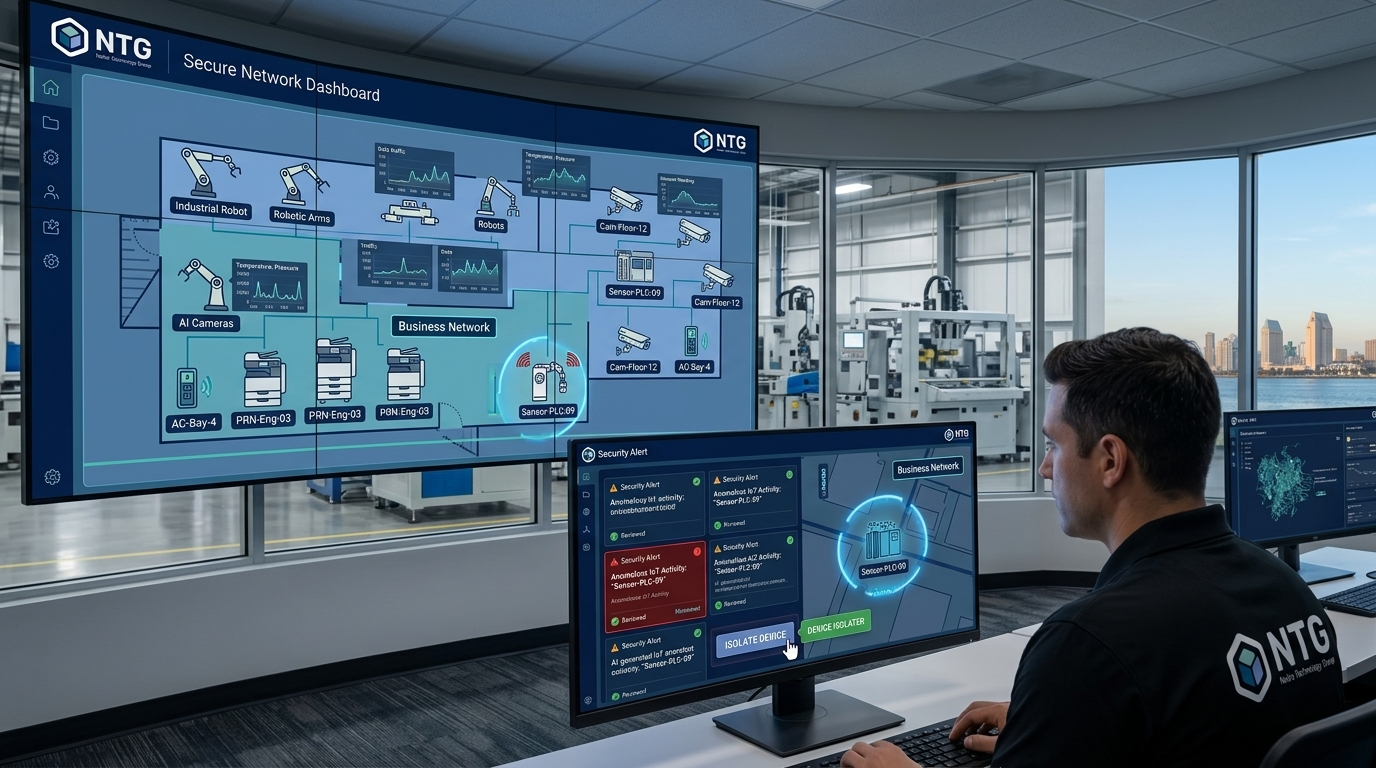
AI-powered IoT threat detection helps close that visibility gap. It gives businesses a better way to identify connected devices, understand their normal behavior, detect unusual activity, and respond faster when something is wrong.
As someone who has spent years helping businesses improve their IT infrastructure and cybersecurity, I believe the real question is not whether your company uses IoT devices.
The question is whether you can see, manage, and secure every device that is already connected.
What Is an IoT Device in a Business Environment?
IoT stands for the Internet of Things. In plain English, an IoT device is a physical device that connects to a network so it can send information, receive instructions, or communicate with another system.
Some IoT devices are obvious. Others blend into the background so well that nobody thinks of them as part of the company’s technology infrastructure.
Common business IoT devices include:
- Security cameras and recording systems
- Smart thermostats and HVAC controllers
- Network-connected printers and multifunction copiers
- Door access and badge systems
- Digital signage
- Conference room displays
- Voice-over-IP phones
- Environmental monitoring sensors
- Warehouse scanners and tracking devices
- Medical and diagnostic equipment
- Building automation systems
- Manufacturing sensors and connected machinery
- Shipping, logistics, and fleet-tracking devices
- Smart lighting and energy-management systems
Every one of these devices may have an operating system, network address, password, firmware, administrative portal, and connection to another service.
That means every device needs to be treated as part of your cybersecurity environment.
The challenge is that connected equipment is often purchased and installed outside the normal IT process. A department may buy a camera system. A facilities vendor may install an HVAC controller. An employee may connect a smart display to the office Wi-Fi.
If nobody documents or monitors those devices, the business develops blind spots. This is one form of shadow IT, and it can grow quickly as a company adds people, locations, equipment, and vendors.
Why IoT Devices Can Become a Serious Cybersecurity Risk
Many IoT products are designed first for convenience, cost, and ease of installation. Security may not receive the same level of attention that it receives in a properly managed business computer, server, or firewall.
That does not mean every IoT device is insecure. It means businesses should not assume a device is safe simply because it is new, useful, or sold by a recognized manufacturer.
Common IoT security weaknesses include:
- Default usernames and passwords that were never changed
- Shared administrator credentials
- Outdated firmware containing known vulnerabilities
- Devices that are no longer supported by the manufacturer
- Unencrypted or poorly protected communications
- Unnecessary internet access
- Open management ports
- Weak remote-access configurations
- Excessive network permissions
- A lack of logging or security monitoring
- No clear person responsible for maintaining the device
A vulnerable device can create more than a technical inconvenience. It can affect uptime, privacy, contracts, compliance, customer relationships, and insurance coverage.
If an attacker compromises a connected device, the attacker may attempt to use it as a foothold. From there, the attacker may look for other systems, credentials, servers, cloud services, or sensitive information.
This is called lateral movement. It is one of the reasons network segmentation and continuous monitoring matter so much.
The smallest device on your network can create a very large business problem if it is trusted more than it should be.
A sound cybersecurity plan should therefore answer three basic questions:
- What is connected to the network?
- What is each device allowed to access?
- How will we know when a device begins behaving abnormally?
Why Traditional IT Monitoring May Miss IoT Threats
Traditional IT monitoring usually focuses on familiar endpoints such as desktops, laptops, servers, and certain network devices. Those systems can often run management, antivirus, or endpoint detection software.
Many IoT devices cannot run a traditional security agent. They may have limited processing power, a closed operating system, or minimal configuration options.
That makes network-level visibility especially important.
It is also unrealistic to expect a person to manually review every network connection made by every camera, printer, sensor, and access controller throughout the day.
Even a smaller organization can generate an overwhelming amount of activity. A larger business with several locations may have hundreds or thousands of connected assets communicating with internal systems, external services, vendors, and cloud platforms.
Manual oversight still matters, but teams need tools that help them find the activity that deserves human attention.
This is where artificial intelligence and machine learning can provide value. Instead of treating every event as equally important, an AI-enabled security platform can evaluate patterns and help identify activity that differs from the device’s expected behavior.
That does not eliminate the need for experienced IT support or cybersecurity professionals. It gives those professionals better information and a faster way to focus on the most meaningful risks.
How AI-Powered IoT Threat Detection Works
AI-powered IoT threat detection continuously evaluates information about devices and network activity. Depending on the technology being used, it may review communication patterns, destinations, authentication behavior, traffic volume, protocols, timing, and relationships between systems.
The objective is to establish what normal looks like and then identify meaningful deviations.
For example, imagine that a security camera normally sends video to a local recording server. It communicates with the same systems every day and uses roughly the same amount of bandwidth.
If that camera suddenly begins communicating with an unfamiliar external server in the middle of the night, that activity deserves attention.
A rule-based system can detect known conditions. AI and machine learning can add another layer by identifying patterns that may not match a simple predefined rule.
The following functions are especially useful in an IoT security program.
1. Behavioral Baselining
Behavioral baselining establishes a profile of a device’s normal operation.
The platform may learn:
- When the device is normally active
- Which internal systems it communicates with
- Which external services it contacts
- How much data it typically transfers
- Which protocols it normally uses
- Whether its behavior changes during certain business processes
Once the baseline is established, the system can flag unusual behavior for investigation.
This is useful because compromised devices do not always stop working. A camera may continue recording. A printer may continue printing. A sensor may continue reporting temperatures.
From the employee’s perspective, everything may appear normal while the device is performing additional unauthorized activity in the background.
2. Automated Asset Discovery
You cannot secure equipment you do not know exists.
Automated asset discovery helps identify devices as they appear on the network. A capable discovery process may help classify a device by type, manufacturer, network location, communication behavior, or other available information.
This can reveal:
- Unauthorized devices
- Previously undocumented equipment
- Duplicate systems
- Devices connected to the wrong network
- Legacy equipment that should be reviewed
- Devices with uncertain ownership
Discovery is the foundation of good asset management. It is also an important part of managed IT services because a dependable technology plan starts with an accurate understanding of the environment.
3. Intelligent Anomaly Detection
Anomaly detection looks for activity that falls outside the expected pattern.
Potential examples include:
- A device contacting a new external destination
- A large increase in outbound traffic
- Repeated authentication failures
- Communication using an unexpected protocol
- A device scanning other systems on the network
- Activity during a time when the device is normally idle
- An unexpected change in the systems the device can reach
An anomaly is not automatically proof of an attack. It is a signal that deserves evaluation.
The quality of the response depends on the larger security process. Alerts need context, prioritization, investigation, and appropriate action.
4. Faster Containment
Detection is only useful if it leads to a timely and appropriate response.
When properly integrated with compatible security tools and established response policies, a detected threat may lead to actions such as:
- Blocking a malicious connection
- Restricting the device’s access
- Moving the device into a quarantine network
- Creating an incident for investigation
- Alerting the responsible IT or security team
- Preserving relevant logs for review
Automation should be carefully planned. Not every unusual event should trigger a disruptive action. A poorly designed response could interrupt a legitimate business process.
The goal is not automation for its own sake. The goal is faster, more consistent decision-making based on the risk and importance of the affected system.
Why Network Segmentation Matters
One of the most practical ways to reduce IoT risk is to limit what connected devices can access.
A security camera normally does not need the same access as an accounting workstation. A thermostat does not need unrestricted communication with a server containing controlled or sensitive information. A guest device should not sit on the same trusted network as production equipment.
Network segmentation separates devices according to their purpose, sensitivity, and required communications.
A well-designed segmentation plan can help:
- Limit lateral movement
- Reduce unnecessary communication
- Protect sensitive business systems
- Separate guest, employee, production, and IoT traffic
- Make unusual behavior easier to identify
- Support compliance and audit readiness
Segmentation is not accomplished by creating random networks and hoping for the best. The business first needs to understand how information moves, which systems depend on one another, and what could happen if communication is interrupted.
This is where experienced IT consulting from Noble Technology Group can help. We approach network design from both a technical and business perspective because security controls still have to support real operations.
IoT Security, CMMC, and NIST SP 800-171
For manufacturers, aerospace and defense subcontractors, and other organizations working with federal contract information or controlled unclassified information, connected devices should not be treated as an afterthought.
The first step is understanding the environment and the applicable scope. Organizations need to know where protected information is processed, stored, or transmitted and which systems can affect the security of that environment.
An unmanaged device connected to a sensitive network can create documentation, access-control, monitoring, vulnerability-management, and risk-management concerns.
A useful compliance-focused IoT checklist includes:
- Maintain an accurate inventory of connected devices
- Document device ownership and business purpose
- Record firmware and support status
- Change default administrative credentials
- Restrict administrative access
- Segment IoT devices from sensitive systems
- Review logs and alerts where available
- Document approved communications
- Remove or replace unsupported equipment
- Include IoT devices in risk assessments
- Retain evidence showing controls are operating
Compliance is not simply a document stored on a server. It is the ability to show that appropriate controls have been selected, implemented, monitored, and maintained.
Our compliance services help businesses connect technical safeguards with the documentation and evidence needed to support frameworks such as CMMC and NIST SP 800-171.
We have also published guidance for San Diego manufacturers on third-party cyber risk, CMMC compliance, backup testing, and vendor oversight. You can read more in our article, Vendor Breach, Your Risk: What a Third-Party Cyber Incident Means for San Diego Manufacturers.
How IoT Security Relates to Cyber Insurance Requirements
Cyber insurance applications and renewals increasingly require businesses to explain their cybersecurity practices in detail.
The exact questions depend on the carrier, policy, industry, company, and coverage being requested. Businesses may be asked about controls such as multi-factor authentication, backups, endpoint protection, network security, vulnerability management, monitoring, privileged access, incident response, and employee training.
IoT security can affect several of these areas.
If a business cannot identify the devices connected to its environment, it becomes harder to confidently answer questions about asset inventory, patching, vulnerability exposure, network access, and monitoring.
Before completing an application or renewal, consider asking:
- Do we have a current inventory of connected equipment?
- Are default passwords prohibited and verified?
- Do we know which devices are no longer supported?
- Are high-risk devices segmented from essential systems?
- Can we detect unusual device communications?
- Are firmware and configuration updates documented?
- Do we have an incident response process?
- Can we demonstrate that the stated controls are operating?
A cyber insurance application should describe controls that are actually in place, not controls the company intends to add later.
Our role is not to interpret an insurance contract or provide legal advice. Our role is to help businesses understand their technical environment, identify gaps, and implement defensible cybersecurity practices that can also support conversations with their insurance professionals.
AI Does Not Replace Good IT Support
AI is useful, but it is not a substitute for disciplined technology management.
A sophisticated monitoring platform cannot make up for weak passwords, unsupported hardware, excessive permissions, poor network architecture, missing backups, or a lack of accountability.
Effective IoT security requires a combination of:
- Accurate asset inventory
- Secure configuration
- Network segmentation
- Firmware and vulnerability management
- Continuous monitoring
- Qualified alert review
- Documented response procedures
- Management support
- Employee awareness
- Regular risk assessments
AI helps the team work more efficiently by finding relationships and anomalies within large amounts of activity. The human team provides business context, validates the risk, determines the appropriate response, and makes sure technology decisions support the organization.
This balance is central to the way we deliver managed IT services and business IT support. We are not interested in installing another tool simply so we can say it is there. The tool needs to solve a real problem, fit the environment, and produce information that leads to action.
Can AI-Powered IoT Security Integrate With an Existing Network?
In many cases, improving IoT visibility does not require replacing the entire network.
The appropriate approach depends on the existing firewalls, switches, wireless infrastructure, cloud services, device types, locations, and security platforms.
A project may use capabilities already available in the environment, add network monitoring, introduce a compatible security platform, or redesign portions of the network that create unnecessary exposure.
Before recommending a solution, I would want clear answers to the following questions:
- What devices are currently connected?
- Which business functions depend on them?
- What information do they process or transmit?
- Are any devices internet-facing?
- Who administers each device?
- What firewall, switching, and wireless technology is in place?
- Which compliance or contractual requirements apply?
- What monitoring capabilities already exist?
- What would happen if a device were temporarily isolated?
A good implementation starts with discovery and planning. It should not begin with a product recommendation made before anyone understands the environment.
What Business Leaders Should Ask Their IT Provider
You do not need to be a cybersecurity engineer to ask useful questions about IoT risk.
If you are responsible for operations, compliance, finance, technology purchasing, or cyber insurance, ask your current IT provider:
- Can you show me every device connected to our network?
- How do you identify an unauthorized device?
- Which devices are running unsupported firmware?
- Are cameras, printers, and building systems separated from business-critical servers?
- How are unusual communications detected?
- Who reviews the alerts?
- What happens if a device appears compromised?
- How are changes documented?
- How does this support our compliance obligations?
- What evidence can we provide during an audit or insurance renewal?
Watch for answers that are specific, documented, and understandable.
If the answer is simply, “The firewall handles it,” ask for more detail. A firewall is important, but it does not automatically solve inventory, segmentation, firmware, monitoring, access-control, and response problems.
A Practical IoT Security Checklist
If you are unsure where to start, use this checklist as an initial conversation guide.
Inventory and Ownership
- Identify every connected device
- Record its location and business purpose
- Assign an owner
- Document the manufacturer and model
- Record warranty and support status
Passwords and Access
- Change all default credentials
- Use unique administrative passwords
- Restrict remote administration
- Review vendor access
- Use multi-factor authentication when supported
Network Protection
- Separate IoT devices from sensitive systems
- Block unnecessary inbound and outbound communication
- Review internet-facing services
- Document required connections
- Monitor unusual network behavior
Maintenance and Monitoring
- Track firmware versions
- Review manufacturer security notices
- Replace unsupported equipment
- Centralize logs where practical
- Define how alerts will be reviewed and escalated
Governance and Response
- Include IoT risks in security assessments
- Require IT review before new devices are connected
- Document isolation procedures
- Include connected devices in incident-response planning
- Maintain evidence for compliance and insurance reviews
AI and IoT Will Continue Growing Together
The number of systems combining artificial intelligence with connected-device technology is expected to increase significantly.
Transforma Insights forecasts that active AIoT connections will grow from 1.4 billion at the end of 2023 to 9.1 billion at the end of 2033. The research firm defines AIoT in this forecast as AI use cases operating onboard IoT devices.
This growth matters because businesses will be managing more connected technology, more data, and more automated decisions.
AI can help organizations analyze device information closer to the source, identify anomalies, improve operational performance, and make better use of the data their equipment is already generating.
But more capability also requires more responsibility.
Businesses need to understand what their devices are collecting, where the information is going, who can access it, how the equipment is secured, and what happens when something goes wrong.
The companies that handle this well will not treat IoT security as a one-time installation project. They will treat it as an ongoing part of technology management, cybersecurity, compliance, and operational planning.
Is Your Network Seeing Every Connected Device?
If you are responsible for buying IT services, managing operations, meeting compliance requirements, or completing a cyber insurance renewal, you should not have to guess what is connected to your network.
At Noble Technology Group, we help businesses:
- Identify unknown and unmanaged devices
- Improve network visibility
- Evaluate IoT cybersecurity risks
- Segment connected devices from sensitive systems
- Strengthen monitoring and threat detection
- Improve vulnerability-management practices
- Prepare for cyber insurance requirements
- Align cybersecurity controls with CMMC and NIST SP 800-171
- Build a practical technology plan that supports growth
Our managed IT services, IT support, IT consulting, cybersecurity, and compliance services are designed for businesses that want a dependable technology partner, not just someone to repair a computer after it breaks.
If you do not know how many IoT devices are connected, whether they are properly segmented, or how your team would detect a compromised device, this is the right time to find out.
Let’s take a clear, practical look at your environment and identify the risks that deserve attention.
Schedule an Initial Consultation
Frequently Asked Questions About AI-Powered IoT Threat Detection
What is IoT security?
IoT security is the combination of technologies, policies, configurations, and operating practices used to protect connected devices. This includes cameras, printers, sensors, access-control systems, building equipment, medical devices, and manufacturing technology. Effective IoT security addresses device inventory, passwords, firmware, network access, monitoring, segmentation, and incident response.
Why are IoT devices vulnerable to cyberattacks?
IoT devices can become vulnerable when they use default passwords, outdated firmware, unsupported software, unnecessary internet access, weak encryption, or excessive network permissions. Risk also increases when nobody is clearly responsible for maintaining or monitoring the equipment.
How does AI improve IoT threat detection?
AI can evaluate device and network behavior to establish normal patterns. It can then help identify anomalies such as an unfamiliar destination, unusual data transfer, unexpected protocol, repeated login failure, or communication that occurs outside the device’s normal operating pattern.
Can AI automatically stop an IoT cyberattack?
When integrated with compatible security technologies and carefully designed response policies, an AI-enabled platform may help initiate actions such as blocking a connection, restricting device access, creating an incident, or moving a device into quarantine. Automated actions should be planned carefully to avoid interrupting legitimate operations.
What is behavioral baselining?
Behavioral baselining is the process of learning how a device normally behaves. The baseline may include when the device is active, which systems it contacts, how much information it sends, and which protocols it uses. Significant deviations can then be flagged for investigation.
How can I find unknown IoT devices on my business network?
A network discovery and asset-inventory process can help identify connected devices. Depending on the environment, this may use network infrastructure, security platforms, monitoring technology, and manual validation. The results should be documented and assigned to responsible owners.
Do cyber insurance requirements apply to IoT devices?
Cyber insurance applications may ask about controls that affect the entire technology environment, including asset inventory, vulnerability management, network security, access control, monitoring, backups, and incident response. Because IoT devices are part of that environment, unmanaged equipment can make it more difficult to provide complete and accurate answers.
Can IoT devices affect CMMC or NIST SP 800-171 compliance?
They can. The impact depends on the device, network architecture, information flows, and applicable compliance scope. Organizations should identify connected devices, determine whether they can affect sensitive systems, restrict unnecessary access, and maintain documentation supporting the controls they have implemented.
Should small businesses be concerned about IoT security?
Yes. A business does not need thousands of devices to have meaningful exposure. A single improperly configured camera, printer, remote-access controller, or unsupported device may create a weakness. Smaller businesses should focus on inventory, secure passwords, updates, segmentation, and monitoring.
What industries benefit from AI-powered IoT security?
AI-powered IoT security can benefit any organization that relies on connected equipment. It is particularly relevant to manufacturing, aerospace and defense subcontractors, healthcare, logistics, warehousing, professional services, construction, and multi-location businesses.
What are the warning signs of an IoT security problem?
Warning signs can include unknown devices, default credentials, unsupported firmware, unusual internet traffic, unexplained bandwidth use, repeated authentication failures, devices connected to the wrong network, inconsistent documentation, and no defined process for reviewing alerts.
How can Noble Technology Group help secure our IoT environment?
Noble Technology Group can help businesses inventory connected devices, evaluate network architecture, identify security gaps, improve segmentation, strengthen monitoring, and align technical practices with business, compliance, and cyber insurance needs. The process begins with understanding the environment rather than recommending a product before the risks are known.