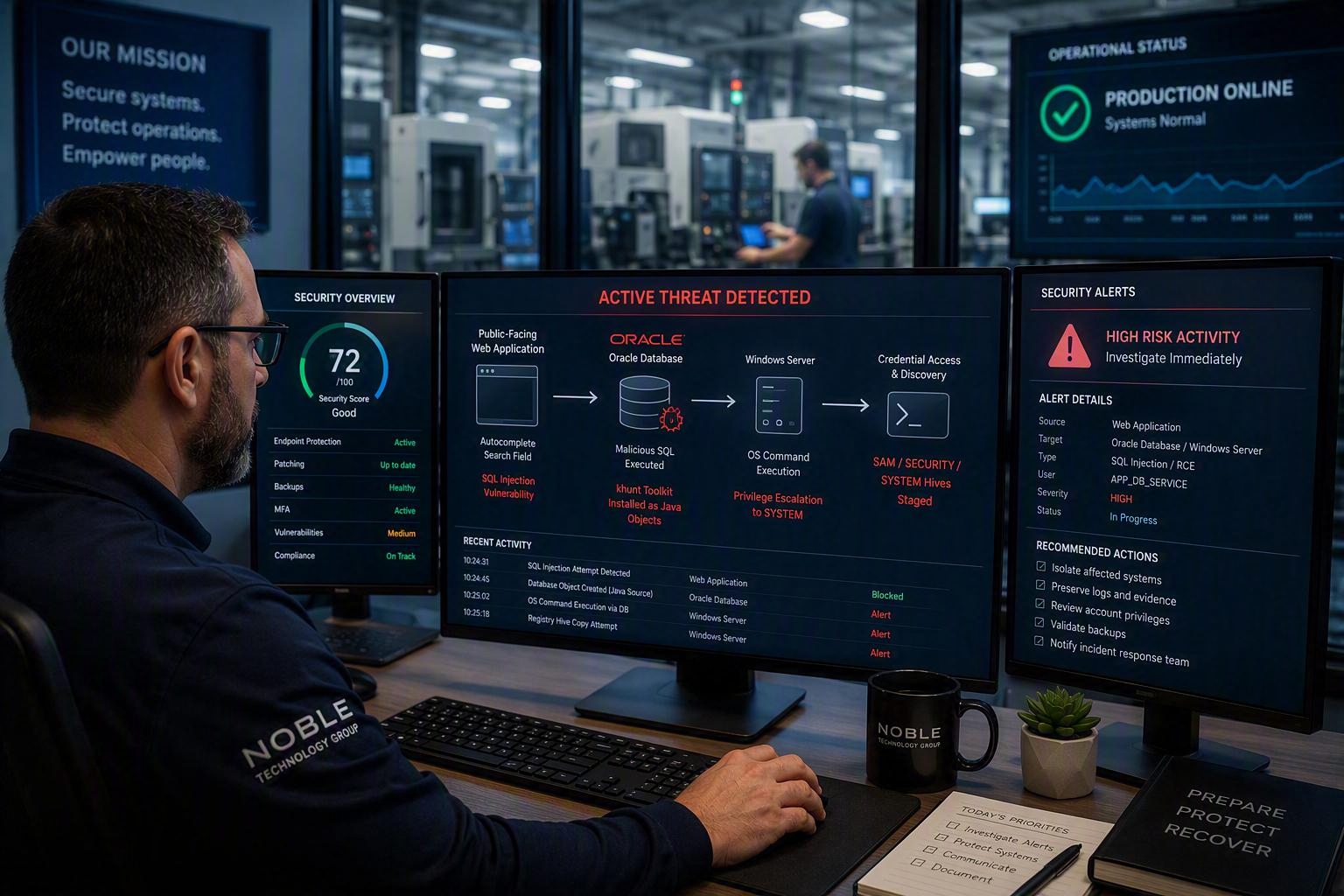
A vulnerable public-facing application can expose more than its database when excessive permissions and limited monitoring allow an attack to spread.
How a SQL Injection Attack Led to a Full Server Takeover: A Business Cybersecurity Guide
By Peter Noble, Founder and CEO of Noble Technology Group
Most business owners do not expect an autocomplete search box to become the front door to their entire server.
But that is exactly why a recent Oracle database attack deserves your attention.
The incident began with a SQL injection vulnerability in a public-facing web application. Attackers entered malicious instructions through a field that did not validate its input correctly. From there, they reached the application’s Oracle database, stored an exploitation toolkit inside the database, executed operating-system commands, and gained SYSTEM-level control of the underlying Windows server.
This was not just a database problem.
It was an application security problem, an access-control problem, a monitoring problem, and a business resilience problem at the same time.
That is the lesson I want business leaders to take from this story.
Most serious cyber incidents are not caused by one dramatic mistake. They happen when several ordinary weaknesses line up at the same time.
At Noble Technology Group, we help businesses build practical cybersecurity risk management programs before a vulnerability becomes an operational crisis. That work may include managed IT services, responsive IT support, strategic IT consulting, managed cybersecurity services, compliance services, and preparation for changing cyber insurance requirements.
You do not need to become an Oracle engineer to learn from this incident. You do need to understand how a small technical weakness can turn into an operational crisis.
What Happened in the Oracle SQL Injection Attack?
Huntress reported that it investigated an incident involving a vulnerable public-facing application connected to an Oracle database. The application accepted malicious SQL commands through an improperly protected form field. The attackers then uploaded a post-exploitation toolkit called khunt as Java source code stored inside Oracle.
The toolkit enabled operating-system command execution, file access, and credential-related activity. The researchers reported that the attackers achieved operating-system-level remote code execution and attempted to collect the Windows SAM, SECURITY, and SYSTEM registry hives.
The technical attack chain was:
- A public-facing field accepted unsafe input.
- The application passed malicious SQL instructions to Oracle.
- The application’s database privileges allowed additional activity.
- Attackers stored Java-based tools inside the database.
- Those tools executed commands on the underlying Windows server.
- Sensitive registry hives were copied for possible credential extraction.
The business explanation is simpler.
An internet-facing application trusted information it should not have trusted. The database account possessed capabilities it should not have possessed. The attackers then abused legitimate functionality to reach the underlying server.
Source: Read the original Huntress investigation.
What Is Cybersecurity Risk Management?
Cybersecurity risk management is the process of identifying the technology, accounts, applications, information, and business operations that could be disrupted by a cyberattack, then prioritizing safeguards based on the likelihood and potential effect of that disruption.
For a small or midsized business, cybersecurity risk management should connect information security to operational questions:
- Which systems keep the company running?
- What information would create the greatest exposure if it were compromised?
- What would happen if an important system stopped?
- How quickly could the business recover?
- Who is responsible for reducing each identified risk?
- How does the company know its safeguards are working?
A good program does not pretend to eliminate every possible threat. It identifies the risks that could cause the most damage and creates a practical plan to prevent, detect, respond to, and recover from them.
That distinction matters.
Cybersecurity should not become an endless shopping list of products. It should be a business process that helps leadership decide what to protect first, which weaknesses require attention, and how much uncertainty the organization is willing to accept.
What Is a SQL Injection Attack?
SQL injection is an application attack in which malicious input changes the database command an application sends to its backend database.
A normal search field might be designed to ask a database:
- Which customer matches this name?
- Which product matches this number?
- Which account matches this email address?
- Which work order contains this term?
- Which inventory item matches this part number?
A vulnerable application may combine the user’s input directly with a database instruction. If that happens, an attacker may be able to enter SQL syntax instead of an ordinary search term.
The database may simply execute the instructions forwarded by the application.
Properly designed applications use protections such as parameterized queries, safe development practices, input validation, and restricted database permissions. These controls help separate user-provided information from the commands sent to the database.
The important point for business leaders is this:
A firewall cannot correct unsafe application code.
A firewall may allow traffic to an application because customers, employees, suppliers, or vendors need to use it. If the application mishandles that legitimate traffic, the attack can arrive through the same doorway the business depends on every day.
How Did the SQL Injection Attack Begin?
According to Huntress, the vulnerable application included a public-facing form that accepted and executed SQL commands without adequately checking whether the submitted content was valid.
Huntress detected credential-theft activity on July 27, 2026, on an endpoint hosting the Oracle database server. Its subsequent investigation connected the activity to the SQL injection flaw.
A search or autocomplete feature may appear minor compared with the rest of a business application.
That is often where risk hides.
A company may carefully secure its email, remote access, laptops, and servers while overlooking:
- A legacy customer portal
- An old supplier interface
- A vendor-built application
- A reporting dashboard
- A public product lookup tool
- A quoting application
- A scheduling portal
- A custom integration no one wants to change
- An application whose original developer is no longer available
Every public-facing application creates a relationship between your business and the internet. Each feature that accepts information should be treated as a possible input channel, not simply as a button or convenience on a web page.
The Vulnerable Field Opened the Door, but Permissions Determined the Damage
SQL injection was the entry point. It was not the only reason the incident became a full server compromise.
The database access available through the application allowed the attackers to do far more than conduct an ordinary search or retrieve routine application information.
That is where a vulnerability became a force multiplier.
In a well-controlled environment, an application account should be restricted to the actions its application requires. A public-facing search tool might need permission to read a narrow set of records. That does not mean it should be allowed to compile Java code, access unrelated database objects, retrieve credential information, or invoke unnecessary procedures.
This security principle is called least privilege.
Least privilege means each user, application, service, and system receives only the access required to perform its authorized function.
In practice, maintaining least privilege can be difficult because organizations want applications to work without interruption.
A familiar pattern looks like this:
- An application encounters an access error.
- Someone expands the account’s permissions to correct it.
- The application begins working again.
- The extra permission is not documented or removed.
- Years later, no one remembers why the account has elevated access.
The business sees a functioning application.
An attacker sees a powerful account sitting behind a vulnerable input field.
The vulnerable field opened the door. Excessive permissions determined how far the attackers could walk.
Questions to Ask About Application and Database Permissions
You do not need to review Oracle database permissions personally. Your IT provider, application developer, database administrator, or security consultant should be able to answer questions such as:
- What database account does the application use?
- What information can that account read?
- What information can it create, modify, or delete?
- Can it access schemas unrelated to the application?
- Can it create procedures or compile code?
- Can it invoke operating-system functionality?
- Can it access password hashes or credential-related information?
- Are application and administrative accounts separated?
- Is the account’s activity logged?
- Who reviews those logs?
- When were the account’s permissions last validated?
- What could happen if the account were compromised today?
If no one can answer these questions, that is useful information.
It means the organization does not yet have enough visibility to make a confident risk decision.
How Did Attackers Store Their Toolkit Inside Oracle?
Oracle Database includes an embedded Java Virtual Machine that supports legitimate development uses, including authorized Java code stored within the database.
In this incident, attackers abused that capability.
Instead of relying only on a conventional malicious executable written to the Windows file system, they uploaded Java source code into Oracle. The code was stored and compiled as schema objects, effectively allowing the database to host part of the attackers’ toolkit.
Huntress identified the toolkit as khunt.
Reported components included capabilities for:
- Executing operating-system commands
- Accessing Oracle username and password-related information
- Browsing and reading files
- Searching the file system
- Testing connectivity
- Extracting compressed archives
The researchers identified components called khuntCmd and khuntHash, which were compiled and stored in the database to support malicious activity.
This matters because many businesses still think of malware as a file.
They expect a malicious program to be downloaded, written to disk, and launched as an obvious process. Modern attackers also look for trusted features they can misuse.
In this case, the database was not merely the target. It became part of the attacker’s operating environment.
How Did Database Access Become Windows Server Control?
The khunt toolkit enabled operating-system command execution.
That changed the scope of the incident.
Once an attacker can execute commands with elevated privileges, the problem is no longer limited to a customer table, product database, or application record. The attacker may be positioned to examine the server, access local files, collect credentials, change settings, or pursue additional systems.
Huntress reported that the attackers achieved operating-system-level remote code execution. Researchers observed copies of the Windows SAM, SECURITY, and SYSTEM registry hives, which can contain information relevant to credential extraction.
It is important to distinguish observed activity from assumed outcomes.
The report establishes that sensitive registry hives were copied and targeted for possible exfiltration and credential dumping. It does not establish every possible action the attackers may have taken or confirm that every staged item left the environment.
Still, an unauthorized party achieving SYSTEM-level command execution is already a serious cybersecurity incident. A business should not wait for confirmed data theft before treating that degree of access as a crisis.
Why Can Database-Resident Threats Be Difficult to Detect?
Most organizations have become better at protecting conventional endpoints.
Security tools commonly monitor:
- Executable files
- Running processes
- Script activity
- Network connections
- Login behavior
- Changes to system settings
- Known malicious patterns
- Suspicious administrative activity
Those controls remain important.
The khunt components, however, were compiled as objects inside Oracle. That is different from a traditional executable sitting on the Windows file system.
Huntress described the database-resident toolkit as the novel aspect of the incident. The company also noted that the general technique had been discussed previously but had rarely been documented in observed attacks.
A security product can only alert on activity it can see and interpret.
Effective threat detection and security monitoring therefore require more than one source of visibility:
- Endpoint activity
- Identity and authentication events
- Firewall and network activity
- Cloud application logs
- Web application logs
- Database audit logs
- Privileged-account actions
- Backup and recovery events
- Incident escalation records
This does not mean every small business needs an enormous security operations center. It means the company should know what its current controls monitor, where visibility ends, and who is responsible for responding when something unusual appears.
A security tool can only alert you to activity it was designed and configured to see.
Five Security Failures Turned One Flaw Into a Takeover
The clearest way to understand this incident is to separate it into five security failures.
1. Unsafe application input
The public-facing application accepted SQL instructions through a field intended for ordinary user input.
2. Excessive database privileges
The available database access permitted actions beyond the application’s legitimate business purpose.
3. Abusable database functionality
Attackers used legitimate Oracle Java functionality to compile and store malicious objects in the database.
4. Limited visibility into database-resident activity
Part of the toolkit operated in a layer that may receive less attention from endpoint-focused monitoring.
5. Access to the underlying operating system
The attackers crossed the boundary from database manipulation to operating-system command execution and credential-related activity.
No single protection should be expected to carry the entire cybersecurity program.
Parameterized queries and input validation could have addressed the original injection risk. Least privilege could have limited the consequences of a compromised application account. Database logging could have improved visibility. Endpoint detection and response could have identified suspicious operating-system behavior. Segmentation and credential protections could have restricted later activity.
That is what defense in depth means.
The same thinking supports broader cyberattack prevention and ransomware prevention. The entry point may change, but the underlying disciplines remain familiar:
- Reduce exposed vulnerabilities
- Restrict unnecessary permissions
- Protect credentials
- Monitor suspicious behavior
- Segment important systems
- Maintain recoverable backups
- Prepare an incident response plan
Defense in depth does not mean buying every cybersecurity product available. It means building overlapping safeguards so one failure does not automatically expose the entire business.
What Does This Attack Mean for Manufacturing Cybersecurity?
Manufacturing cybersecurity is not just about protecting files. It is about protecting production, customer commitments, engineering information, quality records, and the systems people depend on to do their jobs.
Businesses looking for cybersecurity for manufacturers or managed IT services for manufacturers should expect their provider to understand that a technology outage can quickly become a production problem.
A compromised application or server may affect:
- Production scheduling
- Work orders
- Inventory systems
- Shipping information
- Billing
- Customer communication
- Engineering information
- Quality records
- Supplier coordination
- ERP or line-of-business applications
When a critical system stops, people wait. Machines may sit idle. Deliveries may slip. Customer commitments become more difficult to keep.
That is why I believe manufacturing cybersecurity must be connected to operations.
The real questions are not limited to the antivirus installed on each computer:
- Which systems keep production moving?
- How long could the company operate without them?
- Which applications are accessible from the internet?
- Which systems contain sensitive customer information?
- Which accounts could create a major disruption if compromised?
- How would the business communicate during an outage?
- Can the most important systems be restored?
- Has the recovery process been tested?
Effective IT support for manufacturers should account for legacy equipment, specialized applications, vendor access, production schedules, and the cost of unplanned downtime.
Those questions turn cybersecurity from an abstract technical concern into operational planning.
What Does This Mean for Cybersecurity and CMMC Compliance?
Manufacturers, aerospace suppliers, machine shops, and other organizations working in the defense industrial base may face both operational risk and contractual cybersecurity responsibilities.
That is why cybersecurity for defense contractors cannot be separated from access control, documentation, incident response, or CMMC compliance planning.
Requirements associated with CMMC, DFARS, and NIST SP 800-171 reinforce security practices related to access control, system integrity, auditing, incident response, configuration management, and risk assessment.
Compliance does not guarantee that an attack will never happen.
A properly implemented program should make important security practices more consistent, visible, and repeatable.
A company can have a policy stating that access is restricted. The operational questions are:
- Is access actually restricted?
- Can the company show who has access?
- Are elevated permissions approved?
- Are unnecessary permissions removed?
- Are changes documented?
- Are security events reviewed?
- Is evidence retained?
- Does the control still work today?
Policies should become checklists. Checklists should produce evidence. Evidence should create confidence.
Good compliance services should help transform requirements into assigned responsibilities, working safeguards, understandable procedures, and defensible evidence.
The goal is not paperwork for paperwork’s sake. The goal is to make the business more consistent and better prepared.
What Cyber Insurance Requirements Can Businesses Learn From This Attack?
Cyber insurance requirements vary by insurer, policy, industry, requested coverage, and risk profile.
However, the application and renewal process often causes organizations to examine whether important cyber insurance security controls are actually present, working, and documented.
A practical cyber insurance readiness review should go beyond checking boxes. It should verify the underlying security measures and identify where an application, account, backup, or administrative process could create an unexpected exposure.
Depending on the application, an insurer may ask about controls such as:
- Multi-factor authentication
- Endpoint detection and response
- Privileged-account protection
- Patch and vulnerability management
- Protected backups
- Restoration testing
- Security awareness training
- Email security
- Incident response planning
- Administrative access
- Network segmentation
- Logging and monitoring
The Oracle incident shows why accurate answers matter.
A company might say it uses endpoint protection, but does that protection provide visibility into suspicious activity originating through an application or database?
It might say access is restricted, but can a public-facing application account compile code?
It might say backups run every night, but can the organization restore the application and database to a known clean state?
It might say it has an incident response plan, but does the plan identify who will investigate a compromised custom application?
Cyber insurance readiness should not be treated as a form completed once a year. It should be an opportunity to verify that controls are present, understood, documented, and working.
Businesses should review policy-specific questions and coverage interpretations with their insurance broker, carrier, or qualified insurance professional.
How Can a Business Prevent SQL Injection?
Preventing SQL injection begins in application design and development, but an effective program extends beyond the source code.
Application protections
- Use parameterized queries instead of constructing commands from raw user input.
- Validate information submitted through fields and forms.
- Review authentication and session handling.
- Conduct appropriate testing of public-facing applications.
- Include custom, legacy, and third-party applications in vulnerability management.
- Establish ownership for correcting discovered vulnerabilities.
- Remove unused interfaces and application features.
- Reassess applications after significant changes.
Database protections
- Apply least privilege to application accounts.
- Separate application accounts from administrative accounts.
- Restrict code-compilation and procedure capabilities.
- Remove permissions that are no longer needed.
- Protect database credentials.
- Audit privileged database activity.
- Investigate unexpected schema objects.
- Document application dependencies before changing access.
Server and identity protections
- Restrict local and domain administrative access.
- Protect service accounts.
- Monitor privileged authentication activity.
- Review suspicious PowerShell and registry activity.
- Segment critical systems where appropriate.
- Use endpoint monitoring on application and database servers.
- Avoid sharing administrative credentials across systems.
Recovery protections
- Maintain protected backups.
- Define recovery priorities.
- Test application and database restoration.
- Document responsible contacts and vendors.
- Preserve required configuration information.
- Maintain an incident response plan.
- Practice how the business will operate during an outage.
The correct priorities depend on the application and the business.
A small professional office and a manufacturer handling regulated or contract-sensitive information should not receive identical plans. Cybersecurity controls should reflect the company’s technology, operational dependence, data exposure, contractual obligations, and recovery needs.
What Should a Business Cybersecurity Risk Assessment Include?
A cybersecurity risk assessment should identify important systems and information, evaluate relevant threats and vulnerabilities, review existing safeguards, estimate potential business impact, and create a prioritized improvement plan.
It should include public-facing applications, identities, administrative access, endpoints, networks, backups, third-party dependencies, monitoring, and incident response.
Use the following questions as a starting point.
Public-facing systems
- Do we maintain a current inventory of internet-accessible applications?
- Does each application have an identified owner?
- Do we know who developed and currently supports it?
- When was each application last reviewed?
- Are unsupported applications still in production?
Accounts and permissions
- Are application accounts separated from human administrator accounts?
- Do service accounts have only the access they require?
- Are administrative permissions periodically reviewed?
- Are former employee and vendor accounts removed promptly?
- Are access exceptions documented and approved?
Vulnerability management
- How are vulnerabilities identified?
- Who decides which vulnerabilities are addressed first?
- How quickly are internet-facing weaknesses handled?
- Does the process include applications as well as workstations?
- How is remediation verified?
Monitoring and threat detection
- Which systems create security logs?
- Where are those logs retained?
- Who reviews alerts?
- What happens when a high-risk alert appears?
- Are database and application events included?
- Is privileged access monitored?
Backup and business continuity planning
- Which business systems are backed up?
- Are backups protected from unauthorized modification?
- When was the most recent successful restoration test?
- How long would recovery realistically take?
- Who can authorize restoration?
- Which systems must be restored first?
Incident response planning
- Who leads the response?
- Who contacts the cyber insurance carrier?
- Who coordinates with legal counsel?
- Who communicates with employees, customers, and vendors?
- How will the company operate if normal systems are unavailable?
- Has the plan been exercised?
An uncertain answer is not a reason to panic.
It is a reason to investigate and assign responsibility.
When Do Managed IT Services Need Additional Cybersecurity Expertise?
The term managed IT services covers a wide range of responsibilities, and not every provider includes the same security capabilities.
Some businesses may need additional managed cybersecurity services, application-security expertise, database review, compliance support, or incident response planning beyond routine IT administration.
A traditional managed IT provider may focus primarily on:
- Password resets
- Workstation setup
- Microsoft 365 administration
- Helpdesk requests
- Basic monitoring
- Routine updates
Those services are important, but they may not include:
- Web application testing
- Database security reviews
- Privileged-access analysis
- Compliance documentation
- Security architecture
- Incident response planning
- Cyber insurance readiness
- Tested business recovery
- Third-party risk assessment
This is why the service agreement matters.
Business leaders should understand what their IT provider handles, what requires a separate project, what belongs to the application developer, and what remains the client’s responsibility.
Fast IT support is important. But fast support without a security strategy can still leave the business exposed.
A trusted provider should explain those boundaries clearly.
What Should You Expect From Cybersecurity Services for Businesses?
Effective cybersecurity services for businesses should connect technical safeguards to the owner’s real concerns:
- Uptime
- Customer trust
- Financial exposure
- Contractual obligations
- Employee productivity
- Business continuity
- The ability to recover
When evaluating managed IT services, IT consulting, or managed cybersecurity services, look beyond a long product list.
A capable provider should be able to explain:
- What is being protected
- Which systems matter most to operations
- Which risks have been identified
- How administrative access is controlled
- How vulnerabilities are identified and prioritized
- How backups are protected and tested
- How incidents are escalated
- What evidence is maintained
- Which cyber insurance requirements are being supported
- Which services are not included
- What responsibilities remain with the client
- How progress is communicated to leadership
Clear communication is part of good security.
One Noble Technology Group customer, Cole Dick, General Manager of Pacific Crest Services, described the result this way:
“Since switching to NTG, our systems have become streamlined, with minimal downtime to billing, emailing, and customer communication.”
Cole Dick, General Manager, Pacific Crest Services
Cole also cited direct access to me, equipment setup, troubleshooting, and prompt issue resolution as reasons for recommending our company.
Another customer, Sarah Gonzalez, said our team is available to answer her computer questions, provides convenient in-person visits, and helps her feel at ease.
That is what technology should provide: fewer surprises, understandable answers, and confidence that someone is paying attention.
How Noble Technology Group Approaches Cybersecurity Risk
I founded Noble Technology Group to make IT simple, steady, and honest for businesses that need technology to work without becoming a constant distraction.
Noble Technology Group is a La Mesa-based San Diego cybersecurity company providing managed IT services in San Diego, responsive IT support, strategic IT consulting, cybersecurity, infrastructure management, and practical compliance services.
We have a particular focus on cybersecurity for manufacturers, engineering firms, aerospace suppliers, defense subcontractors, and other compliance-conscious organizations where downtime, documentation, and customer requirements matter.
Our approach centers on preventive maintenance, tested restoration, documentation, evidence, clear plans, and accountable support.
We help business leaders answer important questions:
- What could interrupt the business?
- What information must be protected?
- Which risk should be addressed first?
- Which safeguards are already working?
- Where are the gaps?
- Can the business recover?
- Can the organization demonstrate that important controls are working?
- How does the plan support customers, contracts, compliance, and cyber insurance requirements?
The best IT support is not simply the person who arrives fastest after something breaks.
It is a team that responds when needed while steadily reducing the likelihood that the business will face the same disruption again.
Frequently Asked Questions
What is a SQL injection attack?
SQL injection is an application attack in which malicious input changes or adds to a database command generated by an application. Depending on the vulnerability and permissions available, an attacker may be able to read, modify, or delete information or perform other unauthorized actions.
How can SQL injection lead to a server takeover?
SQL injection can become a server compromise when the affected database access has powerful permissions or when database functionality can invoke operating-system actions. In the reported Oracle incident, attackers used database-resident Java objects to support operating-system command execution.
Can endpoint security detect SQL injection?
Endpoint protection may detect suspicious activity that occurs after an injection, but SQL injection begins in the application and database layers. Effective defense also requires secure application development, restricted database permissions, vulnerability management, appropriate logging, and incident monitoring.
Is SQL injection still a risk to modern businesses?
Yes. The Oracle incident investigated by Huntress demonstrates that a long-understood vulnerability class can still create serious risk when application and access safeguards fail.
What is least privilege?
Least privilege is the practice of giving a user, service, or application only the access required to perform its authorized function. This reduces the potential damage if the account is misused or compromised.
What are managed cybersecurity services?
Managed cybersecurity services provide ongoing security capabilities through an external provider. The exact scope varies, so businesses should verify which systems are covered, how alerts are handled, which responsibilities are included, and which needs require a separate engagement.
What is the difference between IT support and cybersecurity services?
IT support is primarily concerned with keeping users and technology working. Cybersecurity services focus on reducing the likelihood and impact of unauthorized access, information exposure, and operational disruption. A managed IT relationship may include both, but the scope should be clearly documented.
Why is cybersecurity important for manufacturers?
Manufacturers depend on applications, networks, production systems, engineering information, supplier access, and customer data. A cybersecurity incident can therefore become a production, delivery, contractual, and customer-trust problem rather than remaining an isolated IT issue.
What security controls may be required for cyber insurance?
Requirements vary by insurer and policy. Applications may ask about controls such as multi-factor authentication, endpoint detection and response, protected backups, administrative access, vulnerability management, security awareness training, email security, and incident response. Policy-specific questions should be reviewed with a qualified insurance professional.
How often should a business conduct a cybersecurity risk assessment?
The appropriate schedule depends on the organization’s risks, obligations, and rate of change. A new public-facing application, major infrastructure change, acquisition, insurance renewal, customer requirement, or security incident can justify an additional assessment.
How can compliance services reduce cybersecurity risk?
Effective compliance services can help convert requirements into working safeguards, assigned responsibilities, documented procedures, and supporting evidence. Compliance does not eliminate cybersecurity risk, but it can improve consistency, accountability, and visibility.
What should manufacturers look for in a managed IT provider?
Manufacturers should look for a provider that understands uptime, recovery priorities, specialized applications, legacy systems, vendor dependencies, security requirements, and documentation. The provider should clearly define what is included, what is excluded, and how responsibilities are divided.
How can a San Diego business evaluate a cybersecurity provider?
A San Diego business should ask how the provider identifies risk, protects privileged access, manages vulnerabilities, tests backups, responds to incidents, documents responsibilities, supports applicable cyber insurance or compliance needs, and reports progress to leadership.
Security Is Built Before the Incident
The Oracle attack is interesting because the attackers stored a toolkit inside a trusted database.
But the most important lesson is not the novelty of khunt.
The lesson is that a vulnerable input field, an overpowered account, legitimate database functionality, and gaps in visibility came together to create a path to server control.
Security is rarely one product.
It is a system of decisions:
- How applications are developed
- How accounts are configured
- How access is reviewed
- How activity is monitored
- How vulnerabilities are corrected
- How systems are backed up
- How incidents are handled
- How leadership verifies that the plan works
You do not need to make your company impossible to attack.
You need to remove preventable openings, limit what compromised accounts can do, detect unusual behavior, and prepare your business to recover.
That is cybersecurity risk management in plain English.
If you are unsure whether your applications, permissions, backups, or security controls would hold up during a real incident, Noble Technology Group can help you get a clear answer.
We will help identify the most important risks, explain them without unnecessary jargon, and build a practical path forward that supports your operations, compliance obligations, and cyber insurance requirements.
Let's replace uncertainty with a clear plan.
About Peter Noble
Peter Noble is the Founder and CEO of Noble Technology Group, a La Mesa-based provider of managed IT services, IT support, IT consulting, cybersecurity, infrastructure management, and compliance services. Peter helps manufacturers, engineering firms, aerospace suppliers, defense subcontractors, and other growing businesses connect technology decisions to uptime, security, documentation, and business goals.