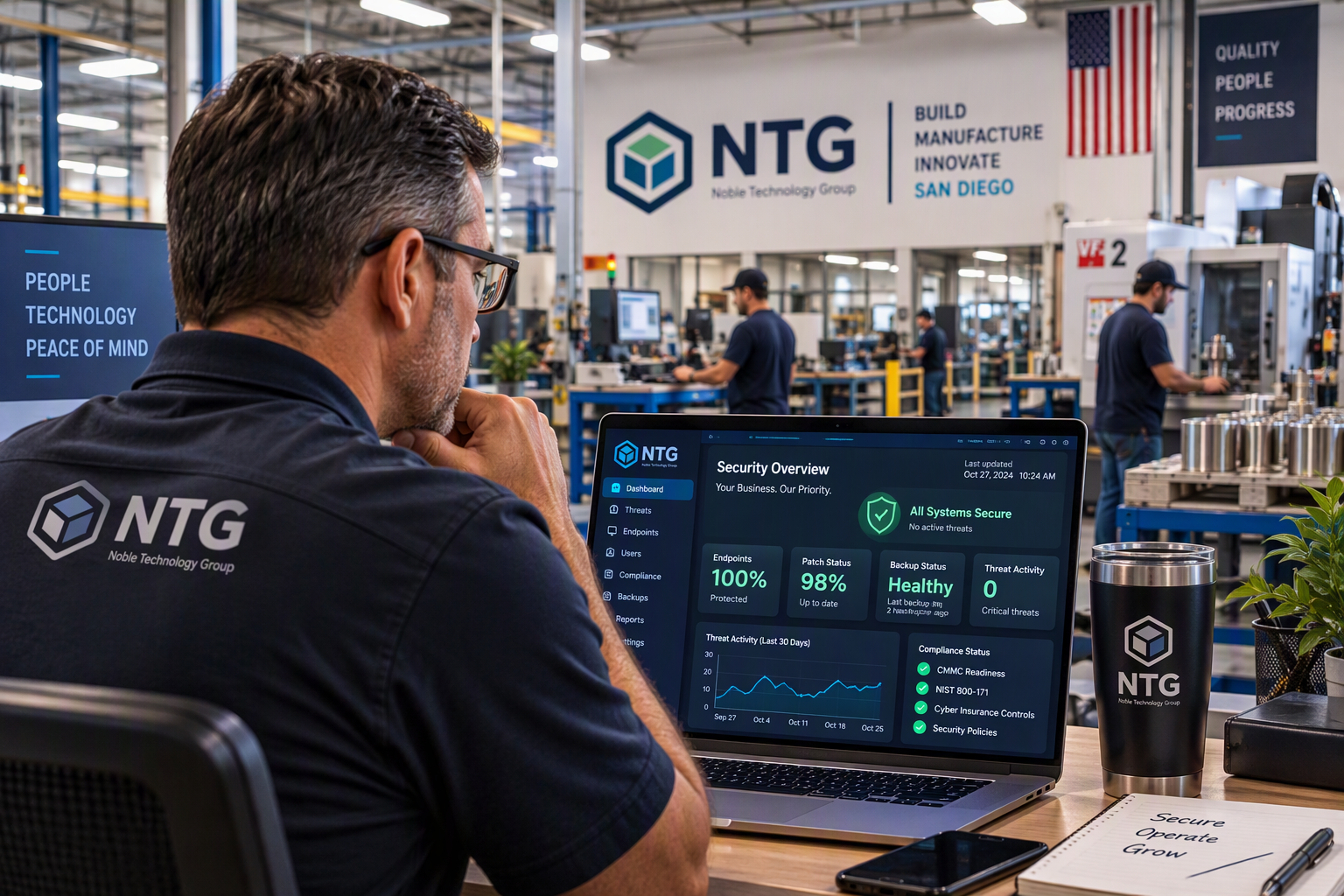
A San Diego operations manager reviews cybersecurity metrics while manufacturing systems remain protected through proactive managed IT services, compliance services, and security monitoring.
Cybersecurity for Small Business: 5 Essential Protections Every San Diego Company Needs
By Peter Noble, Founder & CEO, Noble Technology Group
What would happen if your business could not access its files tomorrow morning?
Could your team process orders, run payroll, answer customers, or keep production moving?
Most companies spend more time preparing for a broken coffee maker than a cyberattack. I understand. A coffee emergency can get ugly. But ransomware is considerably worse for productivity.
Cybersecurity for small business is the combination of technology, policies, employee training, monitoring, and recovery planning used to protect company data and keep operations running.
It is no longer just an IT issue. It affects revenue, customer trust, compliance obligations, cyber insurance requirements, and your ability to operate.
Cybersecurity is not really about computers. It is about making sure your business can still operate tomorrow.
Why Do Small Businesses Need Cybersecurity?
One of the most common things I hear is:
"We're too small for hackers to care about us."
Unfortunately, cybercriminals do not need to care about your company personally. They simply look for opportunities.
Weak passwords, unpatched systems, exposed remote access, and convincing phishing emails create those opportunities.
Your business may possess more valuable information than you realize:
- Customer records
- Employee information
- Financial data
- Contracts and vendor documentation
- Engineering drawings
- Production schedules
- Intellectual property
- Controlled or regulated information
For San Diego manufacturers, machine shops, aerospace suppliers, and defense contractors, losing access to this information can halt production and damage customer relationships.
When I meet with business owners and operations managers, I usually ask:
Which missing file or system would make you break out in a cold sweat?
That is normally where we should begin.
What Cybersecurity Protections Does a Small Business Need?
No single security product protects everything. A practical cybersecurity strategy uses multiple layers of defense so one mistake does not become a company-wide emergency.
1. Multi-Factor Authentication (MFA)
Passwords alone are no longer enough.
Multi-Factor Authentication (MFA) requires an additional verification step before someone can sign in. It can help protect:
- Microsoft 365 accounts
- Email systems
- Cloud applications
- Financial platforms
- Administrative accounts
- Remote access solutions
Think of MFA as the deadbolt on your digital front door.
It may not be exciting, but neither is explaining how a criminal gained access to the owner’s email account.
2. Employee Cybersecurity Training
Your employees do not need to become cybersecurity engineers.
They simply need practical habits that help them recognize trouble before clicking on it.
- Inspect unexpected messages before responding
- Verify unusual payment requests
- Avoid suspicious links and attachments
- Use approved business applications
- Report incidents immediately
Training should be straightforward and ongoing.
If it feels like a three-hour lecture written by a robot, everyone will mentally check out before the second slide.
3. Patch Management and Endpoint Protection
Cybercriminals frequently exploit known weaknesses in software.
A strong patch management process helps keep operating systems and business applications updated with security fixes.
Modern endpoint security can also monitor devices for malware, ransomware, and suspicious activity.
It is not glamorous.
Neither is changing the oil in your truck, but ignoring either one can get expensive.
4. Tested Backups and Disaster Recovery
I tell clients this all the time:
A backup you have not tested is just wishful thinking with a progress bar.
Backups should be protected, monitored, and tested regularly.
Your recovery plan should also identify:
- Which systems must come back first
- How long the business can tolerate downtime
- Who is responsible during recovery
- How data will be restored
One of our clients, Westflex, experienced a devastating fire that destroyed its headquarters. Thanks to planning and preparation, the company was back up and running the very next day.
Learn more about our Data Backup & Recovery Services
5. Continuous Monitoring and Responsive IT Support
Cyber threats do not limit themselves to business hours.
Continuous monitoring helps identify suspicious activity earlier so it can be investigated before becoming a major disruption.
This is where proactive managed IT services differ from reactive computer repair.
The goal is not simply fixing something after it breaks.
The goal is minimizing downtime, reducing risk, improving security, and helping your team stay productive.
What Are Common Cyber Insurance Requirements?
Cyber insurance requirements vary by carrier and policy, but businesses are commonly asked about:
- Multi-Factor Authentication
- Endpoint protection
- Security awareness training
- Protected backups
- Access controls
- Incident response planning
A checked box on an insurance application is not a security control.
Good IT consulting can help determine what protections are actually in place before renewal time arrives.
How Do Cybersecurity and Compliance Work Together?
Cybersecurity controls frequently support compliance obligations.
Depending on your organization, that may include:
- CMMC
- NIST SP 800-171
- HIPAA
- PCI DSS
- Customer security questionnaires
- Vendor security requirements
Noble Technology Group provides compliance services that include assessments, documentation, policy development, employee training, and ongoing compliance support.
“Noble partnered with our IT team and helped us build a compliant enclave network tailored specifically for our critical stakeholders. Within a year, we were securely managing CUI and communicating with a Defense Prime on sensitive research projects, all without compromising efficiency.”
— Mike “MK” Kister, VP of Marketing & Product Management, Novagard
Explore Our CMMC Compliance Services
Cybersecurity Is a Business Decision
The strongest cybersecurity strategy is not the one with the most software.
It is the one that fits your risks, operations, compliance obligations, employees, and recovery requirements.
At Noble Technology Group, we bring together:
- Managed IT Services
- IT Support
- IT Consulting
- Cybersecurity Services
- Compliance Services
- Disaster Recovery Planning
No unnecessary scare tactics.
No mystery.
And no technical alphabet soup unless the government requires the alphabet soup.
Ready to Reduce Risk?
If you are unsure whether your current cybersecurity protections address today's threats, compliance obligations, or cyber insurance requirements, let's identify the gaps before someone else does.
Schedule Your Initial Consultation
Frequently Asked Questions
What is cybersecurity for small business?
Cybersecurity for small business includes technology, policies, employee training, monitoring, and recovery planning used to protect company data and operations.
Can managed IT services improve cybersecurity?
Yes. Managed IT services help coordinate patching, monitoring, endpoint protection, backups, documentation, and security planning as part of a single strategy.
How often should cybersecurity be reviewed?
At minimum annually, and whenever significant technology, compliance, business, or insurance changes occur.
Do manufacturers need specialized cybersecurity?
Many manufacturers require security controls that protect engineering files, production systems, intellectual property, and customer information. Defense contractors may also have CMMC and NIST requirements.