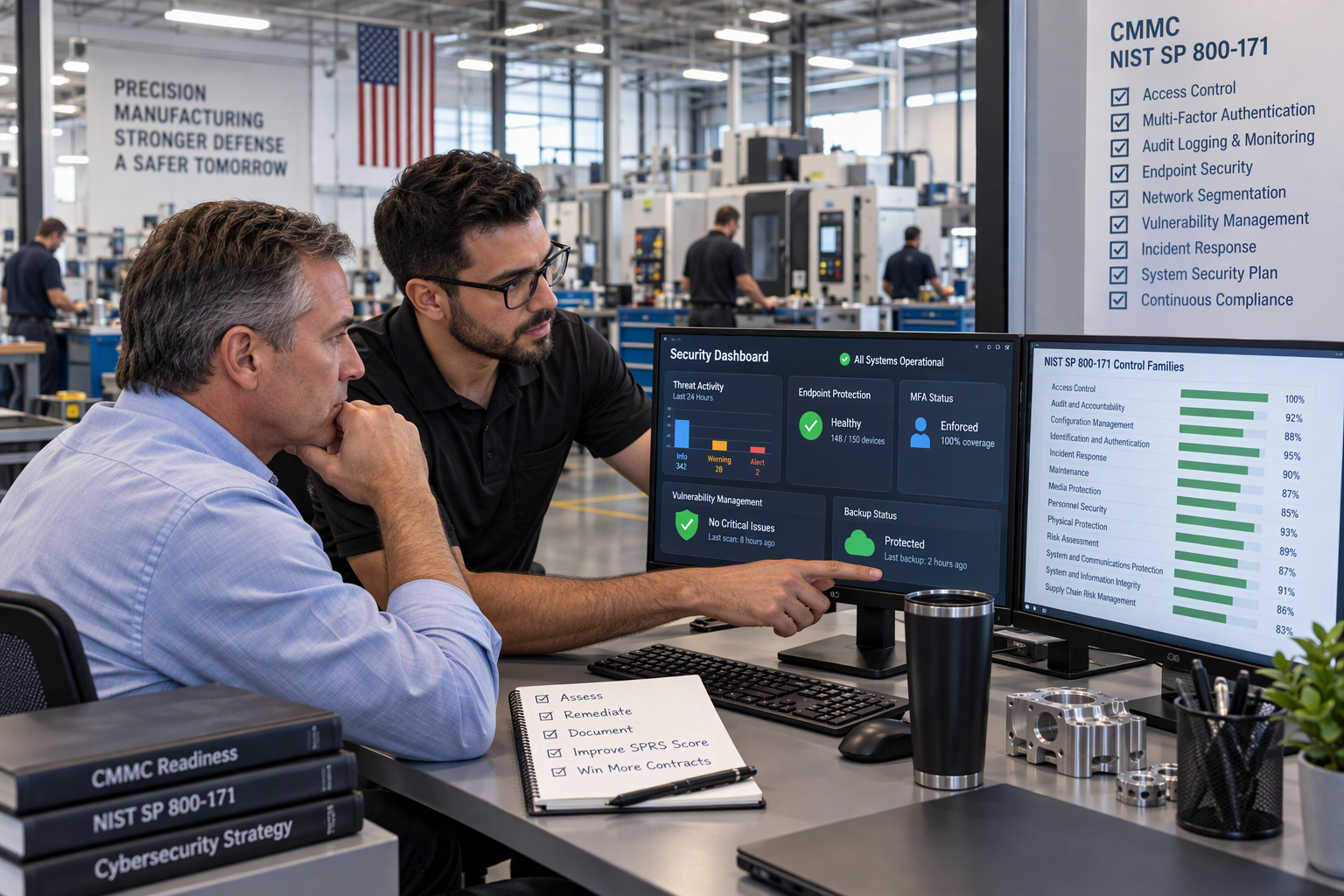
Improving an SPRS score requires more than documentation. CMMC technical remediation can include MFA, endpoint security, audit logging, network segmentation, vulnerability management, and access controls.
Can One IT Firm Improve Your SPRS Score and Implement the Technical Controls?
By Peter Noble, Founder and CEO, Noble Technology Group
Yes. A qualified compliance focused IT firm can help you improve your SPRS score and implement the technical controls behind that improvement, including multifactor authentication, logging, endpoint hardening, access controls, and network security.
You do not necessarily need one CMMC consultant to identify the gaps, another cybersecurity company to recommend solutions, and a third IT provider to implement them. For many small and midsized defense contractors, that fragmented approach creates more meetings, more delays, and more opportunities for an important task to fall between vendors.
There is one important distinction. Your implementation partner can help prepare and remediate your environment, but when an independent CMMC assessment is required, that assessment belongs with the appropriate authorized assessment organization.
I am Peter Noble, Founder and CEO of Noble Technology Group. We work with manufacturers and defense contractors that want the compliance requirements on paper connected to the actual IT work required to satisfy them.
The goal is not to make your SPRS score look better. The goal is to make your security better, then make sure your assessment accurately reflects it.
What Does It Mean to Improve Your SPRS Score?
Your SPRS score should reflect the implementation of the applicable NIST SP 800 171 security requirements within your covered contractor information system. It is not a marketing grade, and it is not a number that should be adjusted without evidence.
If your assessment identifies a problem with multifactor authentication, the solution is to implement multifactor authentication correctly. If audit logging is incomplete, someone must configure the relevant systems, collect the logs, protect them, and establish a review process. If endpoints are not hardened, someone must change the configurations without disrupting the software your employees need to do their jobs.
That is why SPRS score improvement is fundamentally an implementation project. Documentation is essential, but documentation without technical implementation does not close the gap.
The practical question is not, “How do we raise the number?” The better question is, “What prevents us from legitimately earning a better score, and who is responsible for fixing it?”
Common problems include incomplete multifactor authentication, excessive administrative privileges, weak remote access, missing audit records, inconsistent patching, unsupported systems, poorly defined CUI boundaries, and an SSP that no longer matches the environment.
Sometimes the technology is working, but the company cannot produce objective evidence. Sometimes a policy exists, but the technical control was never implemented. Those are different problems, and a capable provider needs to recognize the difference.
Do You Need a CMMC Consultant, an MSP, or a C3PAO?
The answer depends on the work that needs to be performed. These provider categories have different responsibilities.
Traditional Managed Service Provider
A traditional managed service provider normally handles help desk support, computers, servers, networks, Microsoft 365, patching, backups, firewalls, and user administration.
There are excellent MSPs that have limited experience with NIST SP 800 171, CMMC, CUI, SSP development, POA&M management, or SPRS scoring. That does not make them bad IT companies. It means ordinary managed IT services and compliance focused managed IT services are not automatically the same thing.
CMMC Compliance Consultant
A CMMC compliance consultant may understand the framework, perform a gap assessment, help define scope, develop policies, prepare an SSP, and organize evidence. The challenge begins when the consultant identifies a technical problem but does not have responsibility for the systems.
The consultant says, “You need centralized logging.” The IT provider asks, “Which platform do they want?” Management becomes the translator, and the remediation project slows down.
Compliance Focused Managed IT Provider
A compliance focused managed IT provider connects readiness, documentation, technical remediation, and ongoing operations.
If the assessment identifies an MFA problem, the implementation team addresses MFA. If endpoints need hardening, technicians make the changes. If the CUI environment needs segmentation, engineers work through the network architecture. If documentation needs updating, the compliance team can confirm what the technology actually does.
For many small and midsized defense contractors, this can significantly reduce the number of handoffs between compliance and IT.
Certified Third Party Assessment Organization
A C3PAO has a different role. An authorized C3PAO performs an independent CMMC Level 2 certification assessment when that assessment type is required under the CMMC Program rule.
The simplest way to understand the separation is this: your implementation partner helps you build and maintain the house, and your assessor independently inspects it.
For many small and midsized defense contractors, the most efficient model is one accountable compliance focused IT partner for preparation and implementation, plus an independent assessment organization when required.
How to Improve Your SPRS Score
Step 1: Define Your CUI Scope
Identify where Controlled Unclassified Information is stored, processed, and transmitted. Determine who accesses it, which devices and applications handle it, where it is stored, what networks carry it, and which vendors or remote workers can reach it.
Do this before buying security products. If you can legitimately reduce the environment in scope, a properly designed CUI enclave may be more practical than treating the entire company identically.
Scoping mistakes can make remediation unnecessarily expensive. If CUI is copied into email, shared drives, local computers, cloud applications, and production systems without a defined business reason, you may be trying to secure a much larger environment than necessary.
Step 2: Perform a NIST SP 800 171 Gap Assessment
Evaluate the applicable requirements against your actual environment. For each requirement, determine whether it is implemented or not implemented, using the applicable assessment methodology.
A credible assessment relies on evidence. If you say MFA is enforced, show the configuration. If you say logs are reviewed, show the process. If you say backups are tested, show the restore result. If you say privileged access is restricted, show the accounts and approval process.
“We probably do that” is not a defensible assessment position.
Step 3: Establish Your Current SPRS Position
Use the DoD NIST SP 800 171 Assessment Methodology to establish the current score. The score should follow the implementation, not the score you hope to achieve.
An honest baseline gives you something valuable, a starting point. It lets leadership see the size of the gap, understand major dependencies, establish a budget, and measure progress.
Step 4: Separate Documentation Gaps From Technical Gaps
A technical gap requires a change to the environment. A documentation gap may require policies, procedures, diagrams, inventories, or evidence that accurately describe a control already operating.
Many findings involve both. For example, a company may have endpoint protection installed but lack complete deployment, documented configuration standards, alert ownership, and evidence of ongoing review.
Step 5: Build a Prioritized Remediation Roadmap
Every remediation item should identify what is missing, why it matters, who owns it, what it costs, what dependencies exist, when it can be completed, and what evidence will demonstrate completion.
Prioritization should consider the scoring methodology, security risk, contractual urgency, operational impact, budget, and technical dependencies.
Do not treat remediation as a points game. The first responsibility is to protect the environment.
Step 6: Implement the Technical Controls
This is where the spreadsheet becomes real work.
Engineers configure the firewall, deploy MFA, harden workstations, set up logging, review administrative privileges, protect remote access, and address vulnerabilities.
In manufacturing, implementation requires operational judgment. That old computer connected to an expensive machine may not support a modern security agent. A firewall change may interrupt production. A patch may break specialized software.
The solution has to improve security while respecting how the business operates.
Step 7: Collect Objective Evidence
Collect evidence while the work is performed. Do not wait until assessment preparation to search old emails for screenshots.
- Configuration reports
- System screenshots
- Security logs
- Training records
- Vulnerability scan results
- User and administrator records
- Change tickets
- Backup and restore results
- Policies and procedures
- System and software inventories
Evidence collection should become part of operating the environment, not an emergency project before an assessment.
Step 8: Update the SSP and POA&M
The SSP should describe the environment you actually have.
If it says MFA protects an access path, you should be able to demonstrate that protection. If it says logs are reviewed, the review process should be operating. If it describes a system boundary, the boundary should match the systems and connections in use.
The SSP is a map. A map is not useful if it shows roads that do not exist.
The POA&M should not become a parking lot where unresolved problems stay forever. Where POA&M use is allowed, every item needs an owner, a practical remediation plan, a target date, dependencies, and completion evidence.
Step 9: Reassess and Update SPRS
Verify that remediation fixed the gap. Installing a product does not automatically satisfy a security requirement.
Test the configuration, gather the evidence, update the documentation, and reassess against the applicable methodology.
That is how you improve an SPRS score responsibly and then maintain accurate information in the official Supplier Performance Risk System.
What Does CMMC Technical Remediation Include?
Multifactor Authentication
“Implement MFA” sounds simple until you identify every access path.
Which users need it? How are privileged accounts handled? What protects remote access? Which applications support modern authentication? What happens with legacy software? How are service accounts managed? What happens when an employee changes phones? How are emergency accounts protected?
A complete MFA project addresses configuration, enrollment, support, exceptions, recovery, reporting, and evidence. It also considers the effect on employees and production workflows.
Endpoint Hardening
Defense contractors may have engineering workstations, office desktops, laptops, shop computers, servers, shared stations, and systems attached to production equipment.
Endpoint hardening can involve operating system configuration, patching, encryption, local administrator restrictions, endpoint detection and response, application control, removable media controls, screen locking, secure configuration baselines, and monitoring.
The goal is not to apply a generic template blindly. The goal is to create an appropriate, supportable configuration for each class of device.
Centralized Logging and Monitoring
Your systems probably produce logs already. That does not mean you have an effective logging program.
You still need to determine which security events are collected, where they are stored, how long they are retained, who reviews them, what creates an alert, who receives that alert, and what happens next.
A logging platform without an operating process can create thousands of events that no one reviews. Technology matters, but ownership and response matter just as much.
Network Security and Segmentation
A manufacturing network may contain employee computers, servers, engineering stations, production equipment, cameras, printers, wireless devices, vendor connections, and older systems.
Not everything belongs in the same security zone. Appropriate segmentation can reduce exposure, support CUI scoping, and limit the effect of a compromised device.
Segmentation must be implemented carefully. Moving a device to another network may break an application. Changing a firewall rule may interrupt production. Restricting vendor access may affect support for critical equipment.
Vulnerability and Patch Management
Finding a vulnerability is only the beginning. Someone has to decide how to address it.
The response may involve operating system updates, application patches, firmware updates, configuration changes, software replacement, firewall restrictions, equipment replacement, or compensating safeguards.
A capable provider also needs an exception and risk process for systems that cannot be patched immediately.
Microsoft 365 and Identity Security
Microsoft 365 can play an important role in a modern contractor environment, but using Microsoft 365 does not automatically satisfy security requirements.
Licensing, identity, device management, access controls, information protection, logging, retention, configuration, and the actual CUI architecture all matter.
The question is not simply, “Do we have Microsoft 365?” The question is, “How are we using it, what information is there, how is access controlled, and how does it fit within our compliance boundary?”
Backup and Recovery
A backup is not proven until you can restore from it.
Good backup management addresses what is protected, how frequently backups run, where copies are stored, who can access them, whether important data is encrypted, how failures are handled, and how regularly restoration is tested.
Recovery planning also needs realistic priorities. Which systems must return first? How long can production wait? Who makes the decision during an incident? Which vendors need to be involved?
Learn more about Noble Technology Group's backup and recovery services.
A Real Client Story: Building a Practical CUI Enclave
One client needed a path toward CMMC Level 2 without unnecessarily rebuilding its entire IT environment.
We worked with the client's existing IT team on an enclave strategy designed around the people and systems that actually needed access to sensitive information.
In an approved testimonial, Mike Kister said the company wanted to become CMMC Level 2 compliant without the disruption or expense of overhauling its entire infrastructure. He credited Noble Technology Group with helping its IT team build an enclave tailored to critical stakeholders. Within a year, the company was securely managing CUI and communicating with a defense prime on sensitive research projects.
“We needed to become CMMC Level 2 compliant, but without the massive disruption or cost of overhauling our entire infrastructure. Noble partnered with our IT team and helped us build a compliant enclave network tailored specifically for our critical stakeholders.”
Mike Kister, Vice President of Marketing and Product Management, Novagard
That is what good remediation should accomplish. The goal is not to sell you the most technology. It is to build the right environment.
CMMC Technical Remediation Has to Work on the Shop Floor
Security advice that ignores operations can create new problems.
A machine shop cannot always reboot a workstation in the middle of a production run. A legacy computer connected to specialized equipment may not support a current operating system. An outside equipment vendor may need remote access, but that access cannot remain uncontrolled. A network change that looks simple on a diagram may affect machines, label printers, inspection equipment, and engineering software.
Before making a change, the implementation team should understand what the system does, who depends on it, what data it touches, what communicates with it, when the safest maintenance window occurs, and how to reverse the change if something goes wrong.
For manufacturers looking for network support San Diego, context matters. You need engineers who understand both the security objective and the operational consequence.
This is one reason local support can still matter. Much of modern IT can be managed remotely, but switches, firewalls, servers, production equipment, wireless access points, and physical work areas exist in the real world.
Noble Technology Group is based in La Mesa and works with manufacturers, defense contractors, engineering firms, and other regulated businesses throughout San Diego County.
A Second Client Story: The Business Still Has to Operate
One Noble Technology Group client experienced a catastrophic event when its headquarters burned down. Systems supporting multiple locations were housed there.
This was not a tabletop exercise. It was a real disaster.
Elliot LeGros, Vice President and Owner of Westflex, described how Noble Technology Group helped the company get back up and running the following day. He also highlighted NTG's ability to handle expected and unexpected IT issues and its understanding of CMMC and government cybersecurity requirements.
Stories like that matter because compliance cannot exist in a vacuum. Security needs to support resilience. A beautiful compliance binder has limited value if the company cannot recover its operations.
That is why backup, tested recovery, documentation, monitoring, and responsive support belong in the same conversation.
Can Your Existing IT Provider Stay Involved?
Yes.
You may already have a good IT provider. You may have an internal IT manager who knows every server, application, machine, and unusual dependency in the company. That knowledge has value.
A compliance focused provider can work alongside internal IT or another provider when responsibilities are clear.
For each requirement, decide whether responsibility belongs to your company, internal IT, the managed service provider, a cloud provider, another technology vendor, or a shared group.
A responsibility matrix prevents one of the most dangerous phrases in compliance:
“I thought they were doing that.”
Multiple providers are not automatically a problem. Unclear ownership is the problem.
Why Ongoing Managed IT Services Matter
Suppose you complete remediation today.
Tomorrow, an employee leaves. Next week, someone installs a new application. Next month, five laptops are replaced. Two months later, a firewall rule changes. Six months from now, the company hires a new engineering team.
Who evaluates those changes? Who maintains MFA? Who confirms endpoint protection is operating? Who updates documentation when the system boundary changes? Who preserves the new evidence?
Compliance is not frozen in time. The environment changes, so the controls require continuous attention.
This is where managed IT services become part of the compliance strategy. Day to day support, identity management, patching, monitoring, backup, vendor coordination, and change control all influence whether the documented security program remains true.
What Good Compliance Focused IT Support Should Feel Like
It should feel a little boring.
Your patches happen. Your backups work. Your logs collect. Your security tools operate. Your employees receive training. Your endpoints are monitored. Your documentation stays current. Alerts go to people who know what to do with them.
Your POA&M gets shorter.
Your leadership receives understandable reporting.
You do not spend every assessment cycle frantically searching through old email for screenshots.
That is mature IT support and services, and boring security is underrated.
How to Evaluate an SPRS and CMMC Provider
Ask Who Actually Implements the Remediation
If the provider identifies a technical deficiency, ask who fixes it. If the answer is another company, ask how the handoff is managed and who remains accountable for completion.
Ask for Manufacturing Experience
Ask about CNC environments, engineering workstations, legacy systems, production scheduling, remote vendor access, network segmentation, and maintenance windows.
The provider does not need to know how to manufacture your product, but it needs to respect the systems and timing that keep production moving.
Ask How Documentation Stays Aligned With Technology
Policies, procedures, the SSP, diagrams, inventories, and control evidence should match the environment. Ask who updates those records after a technical change.
Ask Who Reviews the Logs
Do not settle for “the product collects them.” Ask who receives alerts, what creates escalation, how incidents are documented, and who owns the response.
Ask How Evidence Is Collected
A good answer will include recurring reports, tickets, configuration records, screenshots, scans, training records, account reviews, restore results, and other artifacts produced through normal operations.
Ask What Happens After Remediation
Getting ready is one thing. Staying ready is another. Ask who maintains the controls, manages changes, updates documentation, monitors the environment, and supports users after the project ends.
SPRS Score Improvement Services for San Diego Defense Contractors
Noble Technology Group helps connect compliance planning with technical execution for regulated organizations.
Depending on the client's needs and scope, that work can include:
- NIST SP 800 171 gap analysis
- SPRS assessment support
- CMMC readiness
- CUI scoping and enclave planning
- SSP and POA&M support
- Remediation planning
- Multifactor authentication
- Endpoint security and EDR
- Logging and monitoring
- Microsoft 365 security
- Network security and segmentation
- Vulnerability management
- Backup and recovery
- Evidence collection
- Ongoing managed IT services
For organizations evaluating IT services San Diego, the real requirement may be larger than help desk support. Your IT company may also need to understand CUI, CMMC, NIST SP 800 171, production systems, secure remote access, endpoint security, and evidence collection.
For companies searching for IT support San Diego, Noble Technology Group provides a combination of local accountability, remote support, onsite capability, cybersecurity, compliance focused services, and infrastructure management.
Learn more about our CMMC compliance services.
Frequently Asked Questions
Can one company improve our SPRS score and implement the technical controls?
Yes. A qualified compliance focused IT provider can assess your NIST SP 800 171 implementation, identify the gaps affecting your score, build a remediation plan, and implement controls such as MFA, endpoint hardening, logging, monitoring, network security, and access control. When an independent CMMC assessment is required, that assessment remains with the appropriate authorized assessment organization.
How do you improve an SPRS score?
Establish an accurate baseline, identify unimplemented NIST SP 800 171 requirements, remediate the underlying technical and administrative gaps, collect evidence, update the SSP and supporting documents, verify the controls, and then reassess. The score should improve because the security implementation improved.
Can an MSP help with CMMC compliance?
Yes, if the MSP has appropriate compliance and cybersecurity capabilities. Ask specifically about SPRS assessment support, CUI scoping, SSPs, POA&Ms, evidence collection, technical remediation, and ongoing control maintenance.
Do we need both a CMMC consultant and an MSP?
Not necessarily. A compliance focused managed IT provider can potentially perform readiness work and implement many of the associated technical controls. Separate independent assessment requirements still need to be respected when they apply.
What technical controls are commonly involved in CMMC remediation?
Common work includes MFA, endpoint security, identity management, logging, monitoring, network segmentation, encryption, secure remote access, vulnerability scanning, patch management, backup protection, configuration management, and access control. Your actual requirements depend on your current environment, scope, contracts, and assessment findings.
Can we use a CUI enclave?
An appropriately designed enclave can sometimes reduce scope by limiting CUI handling to specific users, systems, applications, and workflows. The architecture must be based on actual data flows and applicable requirements, not simply labeled an enclave.
What is the difference between a CMMC consultant and a C3PAO?
A consultant can help your company understand requirements, identify gaps, implement remediation, prepare documentation, and organize evidence. An authorized C3PAO performs an independent CMMC Level 2 certification assessment when that assessment type is required.
Can Noble Technology Group implement CMMC technical controls?
Yes. Noble Technology Group combines compliance focused support with technical implementation and managed IT infrastructure services. Work can include MFA, endpoint security, monitoring, vulnerability management, network security, Microsoft 365, documentation support, evidence collection, and ongoing IT support.
Improve the Security First, Then the SPRS Score
If your SPRS score is lower than it needs to be, do not start by trying to change the number.
Start with the environment.
Determine where your CUI lives. Establish what you have actually implemented. Identify the gaps. Assign responsibility. Implement the technical controls. Collect the evidence. Update the documentation. Then reassess.
Noble Technology Group helps defense contractors connect those pieces, from CMMC readiness and NIST SP 800 171 remediation to managed IT services, endpoint security, MFA, logging, Microsoft 365, and network support San Diego manufacturers can depend on.
If you are wondering whether you need three different companies to solve your SPRS and CMMC challenges, start with a simpler question: what does your environment actually need?
Schedule a consultation with Noble Technology Group. We will help you understand where you are, what needs to change, and who needs to own it.
Your goal is not simply a better SPRS score.
It is better security that justifies the score.