 AI-Powered Cybersecurity: How Businesses Can Stay Ahead of Modern Threats
By Peter Noble, Founder and CEO of Noble Technology Group
Cybersecurity has always been a race between attackers and defenders.
For as long as I have worked in IT, attackers have looked for faster ways to find weaknesses, steal credentials, disrupt operations, and turn ordinary technology problems into expensive business problems. Defenders have responded with stronger tools, better monitoring, improved processes, and more disciplined security controls.
Artificial intelligence is increasing the speed of that race.
Attackers can use AI to review code, create convincing messages, automate reconnaissance, and operate at a scale that would once have required far more time and people. At the same time, cybersecurity teams can use AI to analyze security information, prioritize vulnerabilities, investigate suspicious activity, and reduce the amount of repetitive work that slows down a response.
Microsoft's introduction of MAI-Cyber-1-Flash and Project Perception provides a useful look at where this technology may be headed. These are not simply chatbots that summarize another security report. Microsoft is developing purpose-built models and coordinated agents intended to help defenders perceive, reason over, and respond to cyber risk.
That is an important development, but business owners need to keep it in perspective.
AI-powered cybersecurity is not a substitute for sound IT management. It does not eliminate the need for security policies, reliable backups, employee training, patch management, documentation, or human judgment. Its value comes from helping qualified people see problems sooner and act more efficiently.
AI can accelerate cybersecurity work, but your business still needs people who understand the consequences of every decision.
What Is AI-Powered Cybersecurity?
AI-powered cybersecurity uses artificial intelligence to assist with tasks such as threat detection, vulnerability analysis, security-event investigation, and response prioritization.
Traditional security systems often operate by comparing activity against predefined rules or known patterns. When a rule is triggered, the tool generates an alert. That approach remains valuable, but it can leave an IT or security team with an overwhelming volume of information to review.
AI can add another layer of analysis by looking at relationships among signals.
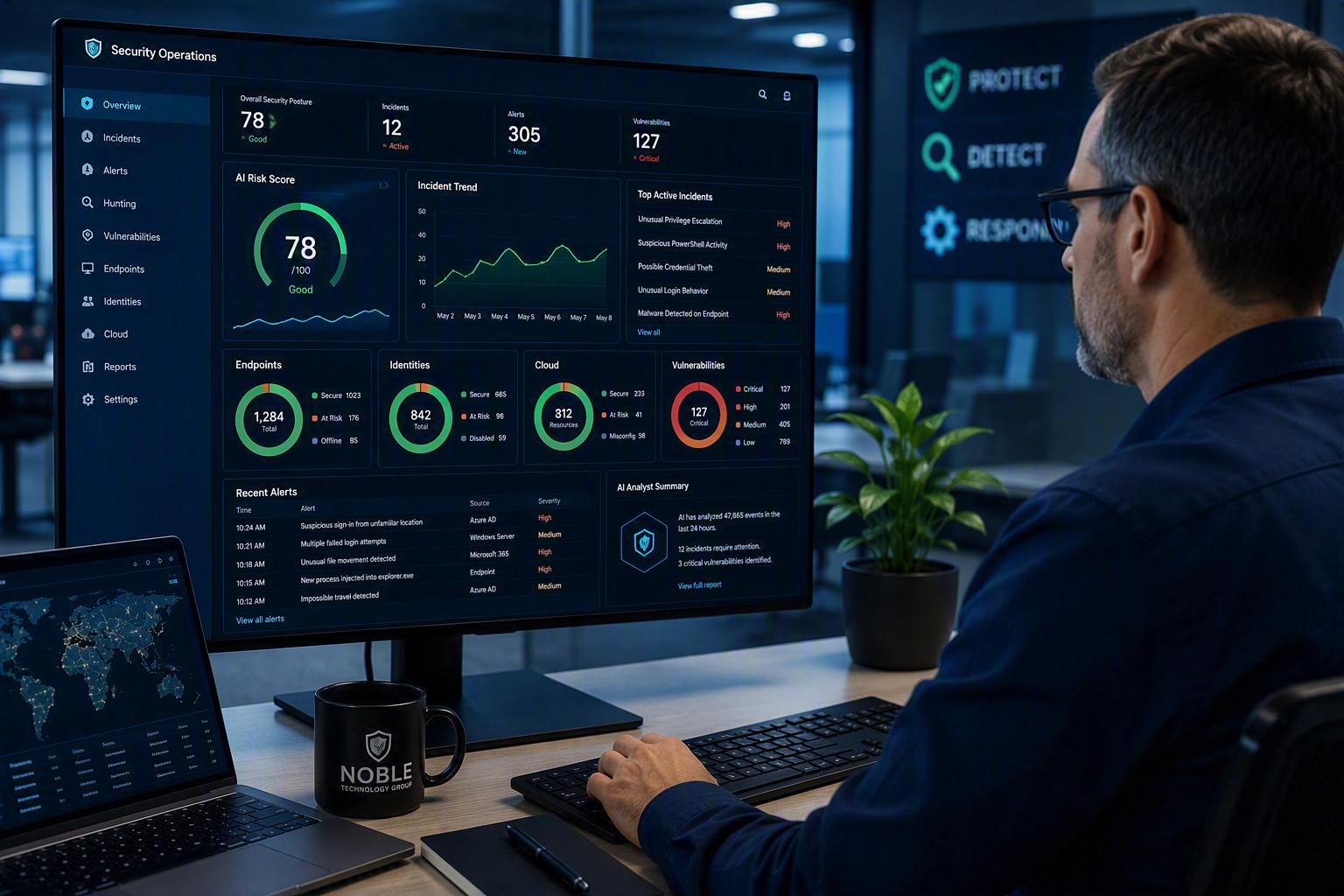
For example, a sign-in from an unfamiliar location may not be enough by itself to confirm an attack. But when that sign-in appears alongside an unusual device, a privileged account change, abnormal file activity, and suspicious email behavior, the combined pattern may require immediate attention.
The practical goal is not to generate more alerts. Most businesses already have enough alerts.
The goal is to help determine:
- What is happening
- Which systems or accounts may be affected
- How serious the risk may be
- What evidence supports the conclusion
- Which issue should be addressed first
- Which actions require human approval
- Whether the response created a new operational problem
For a small or midsized business without an internal security operations center, that improved prioritization could be valuable. However, the technology must be part of a broader security strategy, not treated as a shortcut around one.
Moving From AI Assistance to Agentic Cybersecurity
The term agentic cybersecurity describes AI systems designed to carry out defined sequences of security work rather than only answering a single question.
A conventional assistant might summarize an alert and recommend next steps. An agentic system may be designed to gather related information, analyze it, determine whether additional investigation is needed, propose a response, and pass work to another specialized agent.
Microsoft describes Project Perception as a coordinated system of three agent types:
- Red agents identify potential weaknesses and paths to compromise.
- Blue agents investigate security activity and determine what represents meaningful risk.
- Green agents support remediation and system hardening.
According to Microsoft, these agents share intelligence and work across security data, tools, and workflows. Microsoft also states that defenders set the objectives and guardrails, with high-impact actions remaining under human sign-off.
That last point matters.
When a security action could affect production software, employee access, cloud services, manufacturing systems, line-of-business applications, or customer operations, speed cannot be the only objective. The response must also be appropriate, traceable, and tested.
A fast decision that interrupts production is not automatically a good security outcome.
MAI-Cyber-1-Flash and MDASH
MAI-Cyber-1-Flash is Microsoft's purpose-built cybersecurity model for identifying difficult vulnerabilities in complex codebases. Microsoft says the model is integrated into MDASH, its multi-agent vulnerability identification and remediation system.
According to Microsoft, MAI-Cyber-1-Flash is designed to handle up to 90% of MDASH tasks, while larger models are used for exceptionally difficult cases. Microsoft says MDASH coordinates more than 100 specialized agents across activities that include reconnaissance, codebase scanning, validation, deduplication, proof-of-concept generation, suggested patch creation, and patch validation.
Microsoft reports that its combined MDASH and MAI-Cyber-1-Flash system achieved 96% on CyberGym's “any crash” measure. That result is promising, but it should be understood as a Microsoft-reported benchmark, not a guarantee about the protection any individual business will receive.
Benchmarks can illustrate technical progress. They do not replace:
- A review of the business environment
- Correct product design and configuration
- Ongoing monitoring
- Access-control discipline
- Tested backups
- Incident-response preparation
- Qualified human oversight
For business leaders, the more important takeaway is that vulnerability discovery, validation, and remediation are becoming more integrated. The time between finding a weakness and developing an appropriate response may continue to shrink.
Why AI Cybersecurity Matters to Business Leaders
A business owner or operations manager does not need to understand every technical detail of an AI security model. However, leadership does need to understand the business problem these systems are trying to solve.
IT environments produce more information than most small internal teams can manually review.
A typical business may depend on Microsoft 365 or another cloud productivity platform, laptops, servers, mobile devices, firewalls, cloud applications, backup systems, identity tools, industry-specific software, and third-party vendors.
The difficult question is rarely, “Do we have any alerts?” The better questions are:
- Which alerts represent a credible risk?
- Which assets are essential to operations?
- Which vulnerabilities are exposed to attackers?
- Which accounts have elevated access?
- Which weakness could affect regulated information?
- What can be fixed safely today?
- What requires testing or scheduled downtime?
- Who is accountable for documenting the work?
AI may help analyze those questions faster. Your leadership team and IT partner remain responsible for making sure the answers fit the business.
Better Vulnerability Management, Not Blind Patching
Vulnerability management is often misunderstood as installing updates whenever they become available.
Patching is part of vulnerability management, but the full process is broader. A disciplined vulnerability-management program should help an organization identify affected assets, understand exposure, prioritize risk, assign responsibility, test remediation, approve changes, confirm deployment, and retain evidence.
AI can potentially help correlate a software weakness with threat intelligence, affected systems, identity relationships, past incidents, or the importance of a particular asset. That can help a team decide what needs immediate attention and what should enter a planned remediation cycle.
However, I would not recommend automatic, unrestricted patching across business-critical systems.
Before a major change is deployed, someone should consider:
- Whether the update is compatible with essential software
- Whether a vendor must approve the update
- Whether the change could interrupt production
- Whether a rollback plan exists
- Whether a current backup has been verified
- Whether the change must be documented for compliance
- Whether the fix was validated after deployment
AI Cybersecurity for Manufacturers and Defense Contractors
For manufacturers and defense subcontractors, the priority is not adopting AI because it is new. The priority is protecting operations and meeting contractual requirements without losing sight of how work gets done on the shop floor.
An AI security tool may help investigate a vulnerability, but it does not automatically know:
- Which machine supports an active production run
- Which legacy application requires a specific software version
- Which system handles Controlled Unclassified Information
- Which vendor must approve a configuration change
- Which employee is responsible for documenting the result
- Which evidence an assessor or customer will expect
Businesses working toward CMMC or implementing NIST SP 800-171 need more than software. They need defined responsibilities, appropriate controls, consistent procedures, and evidence showing what was implemented.
That is where Noble Technology Group's San Diego CMMC compliance services can help connect cybersecurity requirements to real operational decisions.
AI, Compliance Services, and Audit Evidence
AI can support compliance work, but it cannot declare a business compliant.
Compliance depends on the applicable framework, contracts, data, systems, policies, implementation, and evidence. A tool may help monitor a control or organize information, but someone must still verify that the control satisfies the requirement.
AI-assisted security platforms may be useful for:
- Identifying possible control gaps
- Correlating alerts across systems
- Prioritizing remediation work
- Tracking changes and approvals
- Organizing security evidence
- Finding inconsistencies in documentation
- Supporting ongoing monitoring
A compliance program should also define who is responsible for each task. Clear ownership prevents important work from getting lost between “we thought IT handled it” and “we thought management approved it.”
AI and Cyber Insurance Requirements
Cyber insurance applications and renewals are forcing many businesses to answer specific questions about their safeguards.
Depending on the insurer and coverage, an organization may be asked about multi-factor authentication, endpoint protection, email security, vulnerability management, backups, employee training, incident response, privileged access, remote access, and security monitoring.
AI-assisted cybersecurity may help monitor or analyze some of these areas, but the tool cannot answer the insurance application on management's behalf.
Every answer should accurately reflect what has been implemented, where it is enforced, how it is monitored, and whether exceptions exist.
Our managed IT services for San Diego businesses are designed to connect daily IT support with cybersecurity, documentation, and longer-term planning.
Why Human Oversight Still Matters
AI can process information quickly. It can also produce an answer that sounds confident without fully understanding your operational context.
That is not a reason to reject AI. It is a reason to use it carefully.
At Noble Technology Group, I think of AI as a force multiplier. It can help a knowledgeable person work faster, review more information, identify relationships, and ask better questions.
Organizations should define:
- What data an AI system may access
- Which actions it may recommend
- Which actions it may perform automatically
- Which actions require approval
- Who can grant that approval
- How activity will be logged
- How decisions can be reviewed
- What happens if the AI system is unavailable or wrong
Business Cybersecurity Readiness Checklist
Identity and Access
- Enable multi-factor authentication where supported.
- Review administrator accounts and privileged roles.
- Remove access promptly when an employee or contractor leaves.
- Use separate administrator and everyday accounts.
- Protect account-recovery methods.
- Review remote-access pathways.
Devices and Endpoint Security
- Maintain an up-to-date inventory of computers and servers.
- Deploy centrally managed endpoint protection.
- Confirm disk encryption on portable devices.
- Replace unsupported operating systems and applications.
- Monitor whether security tools remain active.
Vulnerability and Patch Management
- Scan systems on a defined schedule.
- Prioritize findings according to business risk.
- Assign an owner and target date to remediation work.
- Test business-critical patches where appropriate.
- Document accepted risks and approved exceptions.
- Verify that remediation succeeded.
Backup and Recovery
- Identify essential systems and information.
- Maintain protected backup copies.
- Restrict administrative access to backup systems.
- Monitor backup-job results.
- Test restoration procedures.
- Document recovery priorities.
Email and Employee Security
- Use appropriate email-security controls.
- Train employees to recognize phishing and fraudulent payment requests.
- Provide an easy way to report suspicious messages.
- Verify sensitive financial changes through a separate channel.
- Conduct recurring awareness training.
Incident Response
- Maintain a written incident-response plan.
- Identify internal and external decision-makers.
- Document insurer, legal counsel, IT, and vendor contacts.
- Define who may isolate systems or disable accounts.
- Establish an internal communication plan.
- Preserve relevant evidence.
Compliance, Cyber Insurance, and AI Governance
- Identify applicable legal, contractual, and industry requirements.
- Review cyber insurance requirements before renewal.
- Validate answers before submitting an insurance application.
- Assign responsibility for each required safeguard.
- Identify which AI tools employees currently use.
- Define what information may not be entered into public AI systems.
- Require human approval for high-impact security changes.
- Maintain a manual response path.
How Managed IT Services and AI Work Together
The best use of AI cybersecurity will not be a separate dashboard that no one has time to review. It should fit into a managed process.
- Understand the business and its most important systems.
- Establish a reliable technical baseline.
- Monitor identities, devices, applications, and networks.
- Investigate meaningful alerts.
- Prioritize vulnerabilities.
- Approve and perform remediation.
- Verify the result.
- Document the work.
- Review trends with leadership.
- Update the technology roadmap.
AI may help us reach insight faster. IT consulting helps translate that insight into a sound business decision. Responsive IT support helps employees when a control affects their work. Compliance services help confirm that required processes and evidence remain aligned.
Explore our San Diego managed IT services and data backup and recovery services.
The Future of Cybersecurity Is Human Plus AI
AI-powered cybersecurity is likely to become more capable, more integrated, and more common.
That does not mean every organization should rush to automate every security decision. It means every organization should build the foundation required to use automation responsibly.
The future is not AI replacing cybersecurity professionals. It is experienced professionals using AI to protect businesses more effectively.
At Noble Technology Group, our goal is to make cybersecurity practical. We help businesses connect technology decisions to uptime, security, compliance, and business continuity.
Frequently Asked Questions About AI Cybersecurity
What is AI-powered cybersecurity?
AI-powered cybersecurity uses artificial intelligence to help analyze security information, identify suspicious activity, prioritize vulnerabilities, and support faster response. It works best as part of a managed security process with appropriate human oversight.
How can AI improve cybersecurity for a business?
AI can help correlate security signals, prioritize alerts, identify unusual behavior, organize investigation details, and accelerate repetitive analysis. It does not replace security controls, qualified professionals, or management judgment.
Can AI prevent ransomware?
No security tool can guarantee that ransomware will be prevented. AI-assisted tools may help identify suspicious activity earlier, but businesses still need layered safeguards, employee training, endpoint protection, access controls, patch management, tested backups, and an incident-response plan.
What are AI cybersecurity agents?
AI cybersecurity agents are systems designed to perform defined sequences of security work. Depending on the platform and permissions, they may collect information, analyze activity, prioritize risk, recommend a response, or carry out approved actions.
Will AI replace cybersecurity professionals?
No. AI can accelerate analysis and routine work, but people remain responsible for understanding business context, approving high-impact actions, managing risk, overseeing compliance, and responding to complex incidents.
How does AI support vulnerability management?
AI can assist by correlating vulnerability findings with asset importance, exposure, threat information, and technical context. This can help security teams prioritize remediation, although changes still need appropriate testing, approval, deployment, and validation.
Can AI help with CMMC or NIST SP 800-171?
AI-assisted tools may help identify gaps, monitor safeguards, organize information, or track remediation. They do not establish compliance by themselves. Compliance depends on the organization's scope, implemented controls, policies, procedures, responsibilities, and evidence.
How can AI support cyber insurance requirements?
AI-assisted security tools may support monitoring in areas reviewed by insurers, such as endpoint protection, vulnerability management, identity security, and incident detection. The organization must still verify that every insurance-application answer accurately represents its safeguards.
Is AI cybersecurity practical for small businesses?
It can be, particularly when AI-assisted capabilities are included in security platforms or managed IT services. Suitability and cost depend on the business's risks, systems, compliance obligations, and required level of monitoring.
What should a business do before adopting AI cybersecurity tools?
Start with a risk and control review. Confirm asset inventory, identity security, endpoint protection, patching, backups, employee training, incident-response procedures, compliance responsibilities, and cyber insurance requirements. Then define where AI can improve an existing process.
What are the risks of AI-powered cybersecurity?
Risks may include inaccurate conclusions, excessive permissions, poor data governance, insufficient testing, unclear accountability, and automated actions that disrupt operations. Businesses should establish guardrails, logging, approval thresholds, and fallback processes.
Does AI cybersecurity eliminate the need for managed IT services?
No. AI can strengthen managed IT services by improving analysis and prioritization. Businesses still need people to configure systems, provide support, manage vendors, test changes, document work, make business decisions, and maintain accountability.