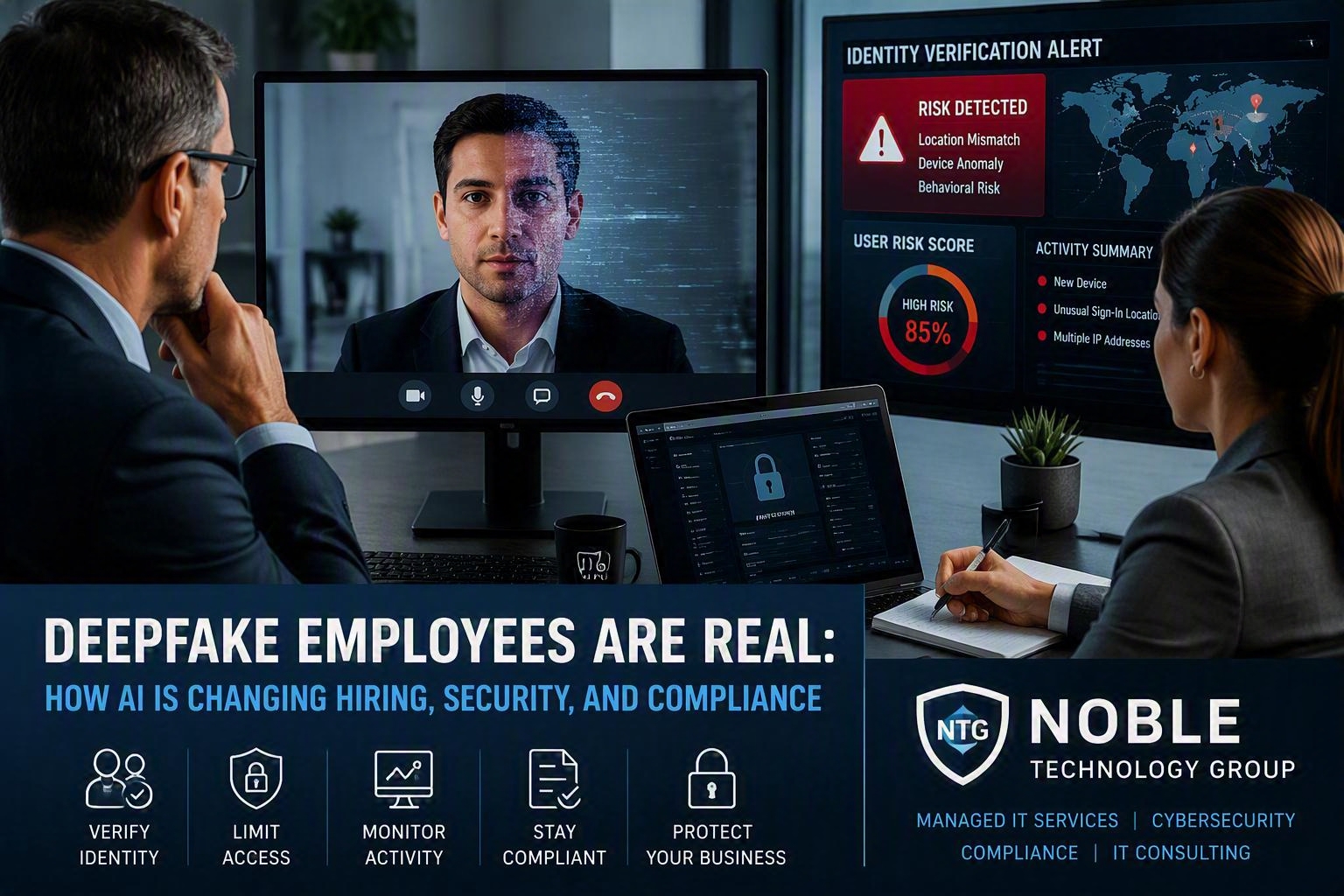
Deepfake Employees Are Real: How AI Is Changing Hiring, Security, and Compliance
By Peter Noble, Founder and CEO of Noble Technology Group
What if the newest person on your team was not who you thought they were?
That question sounds like the beginning of a science-fiction movie. Unfortunately, it has become a real business-security issue.
Cybercriminals and state-sponsored actors are using stolen identities, fabricated résumés, AI-enhanced photographs, face-swapping technology, voice manipulation, remote-access tools, and U.S.-based facilitators to pursue legitimate remote jobs. Their goal may be a paycheck, access to company systems, sensitive information, intellectual property, financial accounts, or some combination of all of those things.
The FBI has warned that fraudulent remote IT workers have used artificial intelligence and face-swapping technology during video interviews to hide their identities. This is not a reason to panic, stop hiring remotely, or treat every applicant with suspicion. It is a reason to recognize that hiring, cybersecurity, human resources, compliance, and IT access management are now connected.
The problem is not AI by itself. The problem is trusting a digital identity without verifying it.
What Are Deepfake Employees?
The term “deepfake employee” generally refers to someone who uses synthetic or manipulated media as part of an effort to obtain employment under a false, stolen, or misleading identity.
The person answering interview questions may be real, but the identity may not belong to them. Their photograph may have been altered. Their voice may be manipulated. Their apparent location may be false. A different person may attend one stage of the interview. Their company-issued computer may be shipped to a U.S. address and then remotely controlled from another country.
A deepfake can be one element of a broader synthetic-identity operation. An attacker may combine:
- A stolen or fabricated identity
- An AI-generated or altered profile image
- A professionally written résumé
- Fraudulent references
- A misleading physical address
- Voice or face manipulation
- A proxy or virtual private network
- A U.S.-based facilitator
- Unauthorized remote-access software
- Multiple people operating through one employee account
That is why simply telling an interviewer to look for video glitches is not an adequate defense. A strange blink, delayed audio, unusual lighting, or awkward eye contact might deserve additional review, but none of those things proves fraud.
Your process must verify identity without turning hiring into guesswork or encouraging unfair assumptions.
A Real Incident Shows How Convincing the Scheme Can Be
One of the clearest public examples came from the security-awareness company KnowBe4. According to the company’s published account, it conducted video interviews, checked references, completed a background check, and hired an applicant who was using a stolen identity and an AI-enhanced photograph.
After the company-issued workstation was received, suspicious activity began. KnowBe4 reported that its endpoint detection and response system alerted its security operations team. The device was contained, and the company said no illegal access was gained and no data was lost, compromised, or exfiltrated.
To me, the most important lesson is that layered security controls provided another opportunity to detect and stop the threat after the applicant passed conventional hiring checks.
No single verification step is perfect. A background check may verify the stolen identity instead of the human using it. A video interview may show a convincing manipulated image. A correct mailing address may belong to a facilitator. Even a company laptop can create false confidence if unauthorized remote access is installed.
Strong security assumes one control can fail. It refuses to let one interview, one document, one password, or one manager’s judgment become the only thing protecting the business.
Why Deepfake Employees Matter to San Diego Businesses
San Diego businesses operate in a region filled with defense contractors, aerospace suppliers, manufacturers, healthcare organizations, financial firms, engineering companies, professional-services firms, and technology businesses.
These organizations may hold valuable information, including:
- Controlled Unclassified Information
- Technical drawings and specifications
- Supplier and customer records
- Patient or employee information
- Product designs and source code
- Banking and payment information
- Credentials for customer environments
- Export-controlled or contract-sensitive information
- Proprietary manufacturing procedures
- Microsoft 365, cloud, and remote-access credentials
The applicant looks like an HR issue until the person receives an email account, computer, cloud access, file permissions, VPN access, payroll profile, and invitations to internal meetings.
At that point, the hiring decision has become an IT-security decision.
The day someone receives credentials, a laptop, and file access, they become part of your security perimeter.
A business does not need to be a Fortune 500 company to be useful to an attacker. A smaller manufacturer may be part of a defense supply chain. A medical practice may hold protected information. A professional-services firm may have access to client systems. Attackers look for valuable access, not just famous company names.
The First Risk Is Unauthorized Access
Once a fraudulent employee is hired, the attacker no longer has to break through the front door in the traditional sense. The business may create the account, issue the device, approve the login, and grant permissions for them.
A firewall cannot determine whether HR hired the correct person. Antivirus cannot correct an excessive permission decision. Multi-factor authentication cannot fully protect an account if the attacker is the person who enrolled the authentication method.
Those tools matter, but they need to be part of a coordinated onboarding process connecting HR, the hiring manager, finance, compliance, and IT.
Before access is granted, the organization should know:
- Who approved the hire
- How the person’s identity was verified
- Where company equipment is being shipped
- What systems the employee needs
- What information the employee will handle
- Who owns the access decision
- Whether the role requires elevated privileges
- How unusual activity will be monitored
- When access will be reviewed
- How access will be disabled if something is wrong
Financial Fraud Can Follow Legitimate-Looking Access
A fabricated employee may gain opportunities to influence payments, payroll, invoices, account information, or internal approvals. The person could also collect information for a later business email compromise attempt.
Businesses should maintain separation of duties and independent verification for high-risk transactions. A change to a vendor’s banking details should not be approved only because it came from a familiar account. A wire request should follow an established approval process even when it appears urgent.
For sensitive actions, build a process that includes:
- Independent approval
- Out-of-band verification
- Documented authorization
- Restricted administrative access
- Logging and review
- Clear escalation when something feels wrong
Deepfake Employees Can Create Compliance Problems
A fraudulent hire can expose weaknesses in access control, identity management, personnel security, audit logging, incident response, vendor oversight, and offboarding.
For defense contractors, CMMC and NIST SP 800-171 place significant emphasis on controlling access to systems and information. Healthcare organizations must control access to electronic protected health information. Other businesses may face customer contracts, privacy obligations, cyber insurance requirements, or industry-specific safeguards.
Hiring a deceptive applicant does not automatically prove that an organization violated a particular regulation. The practical question is whether the organization identified its risks, implemented the safeguards that apply, documented responsibilities, limited access, monitored activity, and responded appropriately.
That is why compliance services should not stop with policy templates. If a control exists only in a binder, it will not stop an attacker.
What This Means for Cyber Insurance Requirements
Cyber insurance applications and renewals often ask detailed questions about controls such as multi-factor authentication, endpoint protection, security-awareness training, backups, privileged access, incident response, email security, patch management, remote access, monitoring, and vendor management.
The exact requirements vary. Work with a qualified insurance broker or legal advisor to interpret your coverage, conditions, and exclusions.
My practical recommendations are:
- Review coverage with a qualified cyber insurance broker or counsel.
- Answer security questionnaires accurately.
- Keep evidence supporting your answers.
- Document implementation and testing.
- Notify the appropriate parties promptly when an incident occurs.
- Do not describe a control as fully implemented if it is not consistently enforced.
Managed IT services and IT consulting can help you understand the technical environment and produce evidence. Coverage interpretation should remain with your insurance and legal professionals.
Why MFA Helps but Does Not Solve Identity Fraud
Multi-factor authentication makes a stolen password less useful and should be enabled for remote access, cloud systems, email, administrative accounts, and other important services wherever supported.
But MFA answers a specific question: Can this user present the required authentication factors?
It does not always answer: Did we hire the correct human being?
A complete identity-security model includes:
- Identity proofing: Are you the person you claim to be?
- Authorization: What are you allowed to access?
- Authentication: How do you prove it is you at sign-in?
- Monitoring: Is the account behaving as expected?
- Revalidation: Do we still trust the identity and access?
- Offboarding: Can access be removed completely and quickly?
Build a Stronger Remote-Hiring Process
The hiring process should be risk-based. The more sensitive the role, the stronger the verification and access controls should be.
Before the interview
- Look for duplicate résumé wording or reused contact information.
- Define the role’s access needs.
- Identify positions that handle sensitive data or privileged systems.
- Train recruiters and managers on synthetic-identity risks.
- Define the escalation process for suspicious applications.
During the interview
- Use consistent, job-related questions.
- Include more than one interviewer for sensitive roles.
- Use an approved identity-verification process.
- Ask follow-up questions that require explanation.
- Document material inconsistencies objectively.
- Move questionable cases into secondary verification.
Before shipping equipment
- Verify the delivery address.
- Record the assigned device and serial number.
- Configure the device before shipment.
- Restrict local administrative rights.
- Block prohibited remote-access tools where practical.
- Place new accounts into a limited onboarding group.
During and after onboarding
- Complete verification before granting sensitive access.
- Use least privilege and staged access.
- Require MFA and secure enrollment.
- Monitor new-user activity.
- Review access after the onboarding period.
- Investigate unexpected locations or concurrent sessions.
- Maintain a prompt offboarding process.
Be Careful With Biometric Verification
Biometric verification may strengthen a hiring process, but it can create privacy, accessibility, retention, consent, security, and employment-law considerations.
Before implementing biometric verification:
- Define the business reason.
- Consult employment and privacy counsel.
- Understand notice and consent requirements.
- Evaluate how biometric data is stored.
- Set retention and deletion rules.
- Provide an appropriate alternative process.
- Evaluate anti-spoofing capabilities.
- Limit access to verification data.
- Review the vendor’s security obligations.
Train HR, Managers, Finance, and IT Together
Security-awareness training should include synthetic identities, unusual onboarding requests, unauthorized remote access, payroll changes, and suspicious account behavior.
The goal is not to turn employees into investigators. It is to teach them what to notice, what not to assume, and where to report concerns.
Good security training does not ask people to become experts. It teaches them when to pause and who to call.
How Managed IT Services Reduce the Risk
A capable managed IT provider can help standardize onboarding, configure devices, deploy endpoint detection and response, manage MFA, enforce least privilege, restrict remote access, centralize logs, protect email, manage patches, review permissions, prepare for incidents, and support compliance evidence.
Responsive IT support matters when something breaks. Proactive IT consulting matters when leaders need to connect hiring, security, compliance, insurance, and operations.
The strongest relationship combines both.
A Practical Executive Checklist
- Do we have a written remote-identity-verification process?
- Are sensitive roles subject to stronger verification?
- Do HR, IT, and managers coordinate before granting access?
- Are new users given minimum necessary access?
- Is access granted in stages?
- Is MFA required?
- Are administrative privileges restricted?
- Can we detect unauthorized remote-control software?
- Can HR and IT quickly suspend an account?
- Does our incident plan address identity fraud?
- Do our written policies match actual practice?
- Can we produce evidence of training and access reviews?
- Are cyber insurance questionnaire answers accurate?
- Are recruiters and staffing providers part of our risk review?
If several answers are “I think so,” the right next step is verification.
Start With a Clear Assessment
Deepfake employees are not the only AI-enabled threat. Criminals can impersonate executives, vendors, customers, applicants, and trusted partners using generated text, manipulated video, cloned voices, stolen identities, and real company information.
The answer is not fear. The answer is a security program in which people, technology, and process support one another.
At Noble Technology Group, we help businesses connect managed IT services, IT support, IT consulting, cybersecurity, compliance services, employee training, and cyber insurance requirements into one practical plan.
If you are unsure whether your hiring, onboarding, identity, cybersecurity, or compliance controls would stand up to today’s AI-powered threats, schedule an initial consultation with Noble Technology Group.
We will help you understand where you stand, establish practical priorities, and build a security approach your people can actually follow.