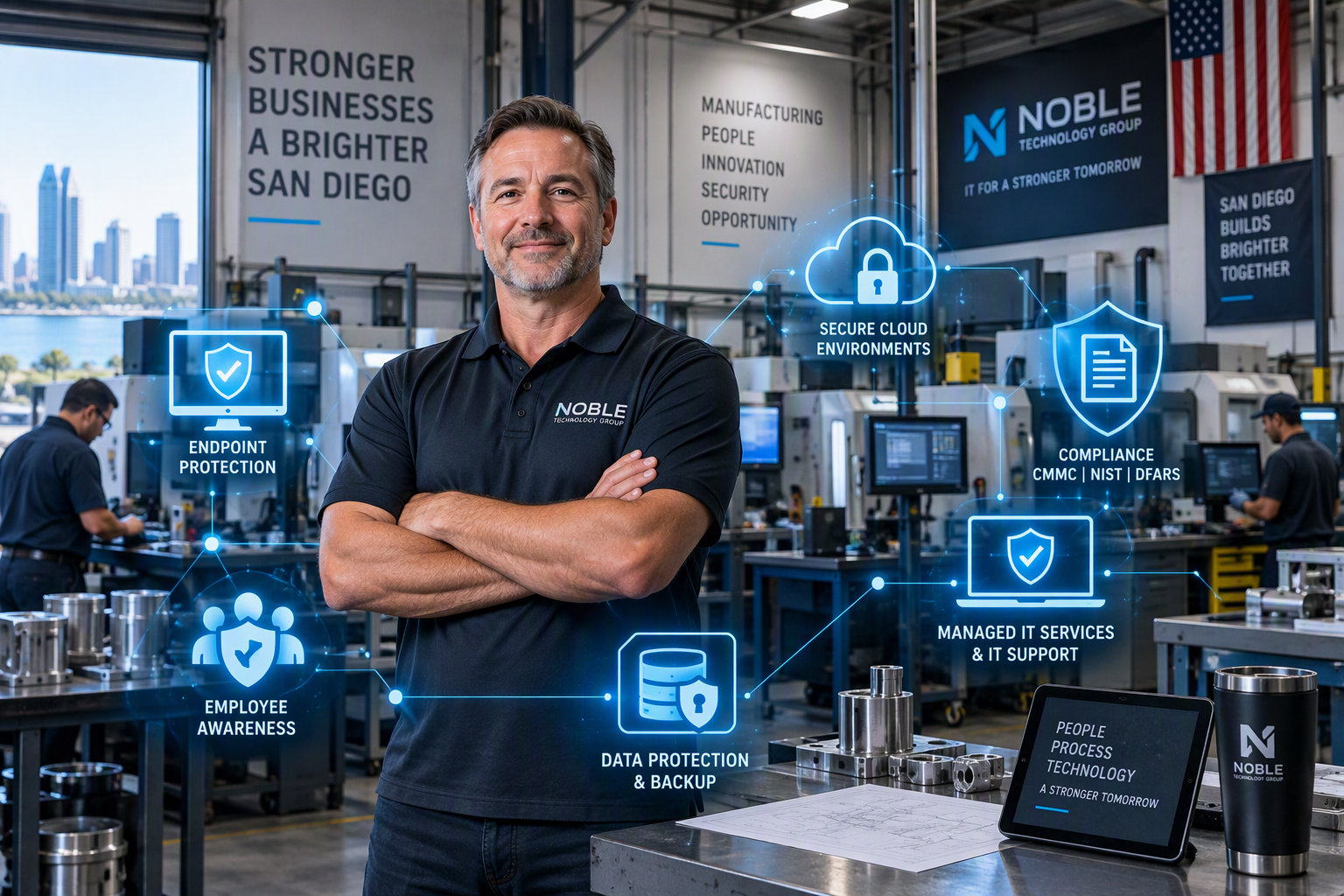
Strong cybersecurity helps San Diego businesses protect operations, meet compliance requirements, satisfy cyber insurance requirements, and reduce the risk of costly downtime.
Cybersecurity for Small Businesses in San Diego: How to Prevent Ransomware, Downtime & Costly Data Breaches
By Peter Noble, Founder & CEO, Noble Technology Group
If I had a nickel for every time a business owner told me, "We're too small for hackers to care about us," I'd probably have enough money to finish every project on my 1968 VW bus.
Actually, that's not true.
It's a Volkswagen. There will always be another project.
But the point stands.
One of the biggest cybersecurity myths I hear from business owners throughout San Diego is the belief that cybercriminals only target large corporations. Many people picture hackers sitting in dark rooms plotting attacks against billion-dollar companies while ignoring smaller businesses.
Unfortunately, that's not how it works.
Cybercriminals don't care whether you have 10 employees or 10,000. They care about one thing: whether your business looks easier to compromise than the business next door.
If your company stores customer information, financial records, employee data, intellectual property, vendor information, engineering drawings, or access to company bank accounts, you already have something worth stealing.
"Cybercriminals don't care how many employees you have. They care how easy you are to break into."
That's exactly why cybersecurity for small businesses in San Diego has become a business necessity, not just an IT concern.
At Noble Technology Group, we've helped organizations recover from cyber incidents, improve resilience, and reduce risk before problems become costly disasters.
Why Small Businesses in San Diego Have Become Prime Targets for Cybercriminals
Most business owners assume cybercriminals specifically choose them.
In reality, many attacks are automated.
Attackers use tools that scan the internet for weak passwords, vulnerable software, outdated systems, and exposed services.
Think of a burglar walking through a neighborhood.
They're rarely looking for the most expensive home.
They're looking for the one with the garage door open.
The same thing happens online every day.
Businesses become targets because they're accessible.
Not because they're famous.
Unfortunately, many small businesses don't have dedicated cybersecurity staff. Owners are busy serving customers, managing employees, handling operations, and keeping the doors open.
Cybersecurity often lands somewhere between:
- Clean out the storage room
- Update the employee handbook
- Figure out why the copier only jams when everyone's in a hurry
Everyone knows cybersecurity is important.
Few people wake up excited to work on it.
"Most companies treat cybersecurity the way people treat flossing. Everyone agrees it's important. Fewer people are excited about actually doing it."
The Real Cost of a Cyberattack Isn't Technology
Most people think a cyberattack is a technology problem.
It's actually a business interruption problem.
When ransomware locks up your systems, your employees stop being productive.
Your accounting team struggles to access records.
Your operations team loses visibility.
Your customer service team can't help customers effectively.
Your production schedule starts slipping.
Technology is a lot like oxygen.
Nobody talks about it while everything is working.
The second it's unavailable, it's suddenly the most important thing in the room.
The financial impact of downtime can include:
- Lost revenue
- Lost productivity
- Customer dissatisfaction
- Operational disruption
- Data recovery expenses
- Cyber insurance claims
- Reputation damage
"Cybersecurity isn't really an IT problem. It's a business continuity problem."
Why Manufacturing, Aerospace & Defense Contractors Face Greater Risks
Many of our clients operate in manufacturing, aerospace, engineering, and defense-related industries throughout San Diego County.
For these organizations, cybersecurity impacts more than just security.
It impacts business opportunities.
Today, customers increasingly expect vendors and subcontractors to demonstrate secure business practices.
Organizations pursuing military or defense-related contracts often encounter requirements tied to:
- CMMC Compliance
- NIST 800-171
- DFARS 7012
- Supply chain cybersecurity requirements
- Cyber insurance requirements
Cybersecurity has evolved from an IT responsibility into a competitive advantage.
Companies with strong compliance programs often find it easier to retain customers, qualify for contracts, and build trust.
Learn more about our Compliance Services HERE
The Five Most Common Cybersecurity Gaps We See
1. Weak Passwords and Poor Credential Management
Passwords continue to be one of the easiest ways for cybercriminals to gain access.
I've seen passwords stored in spreadsheets.
I've seen passwords under keyboards.
I've seen passwords taped to monitors.
To be fair, that certainly makes them easy to find.
Unfortunately, it makes them easy for everyone to find.
Common issues include:
- Password reuse
- Weak passwords
- Shared accounts
- No password manager
- Missing MFA
Strong passwords and multi-factor authentication remain among the most effective security controls available.
2. Outdated Software and Unpatched Systems
One of the most common comments I hear is:
"Everything is working fine. Why should we update it?"
That's understandable.
Nobody likes software updates.
But refusing updates forever is a little like ignoring your vehicle's check engine light because it's still driving.
Technically you're moving.
Strategically you're taking a gamble.
Cybercriminals actively look for organizations running known vulnerabilities.
Routine patching dramatically reduces your risk.
3. Employees Who Are Human
Most security incidents don't happen because employees are careless.
They happen because employees are busy.
A staff member receives what appears to be a legitimate email.
Someone clicks.
Five minutes later everyone is having a much different day than they planned.
Security awareness training teaches employees how to identify:
- Phishing attacks
- Fraudulent requests
- Spoofed emails
- Social engineering scams
- Suspicious attachments
Good employees become a powerful layer of defense when properly trained.
4. Excessive User Permissions
As organizations grow, permissions accumulate.
Someone needs access.
Then they switch departments.
Then they get promoted.
Then nobody remembers what access they still have.
Eventually your permissions structure begins to resemble the famous kitchen junk drawer.
Things keep going in.
Nothing comes out.
User access should align directly with job responsibilities.
5. Backup Systems Nobody Has Tested
This one deserves special attention.
Many organizations proudly tell us:
"We have backups."
Great.
When was the last restore test?
Silence.
Backups are important.
Tested backups are critical.
Owning a fire extinguisher is helpful.
Knowing it works when your kitchen catches fire is even better.
"The best time to discover a security gap is before a ransomware gang discovers it for you."
Why Cyber Insurance Requirements Are Raising the Bar
Cyber insurance companies have become much stricter during the past few years.
And honestly, that's understandable.
Insurance carriers have paid substantial claims resulting from ransomware and business email compromise attacks.
As a result, organizations are being asked tougher questions.
Today's cyber insurance requirements frequently include:
- Multi-factor authentication
- Security awareness training
- Endpoint protection
- Incident response planning
- Backup verification
- Access controls
- Vulnerability management
The application process feels a lot like a physical exam.
You show up expecting paperwork.
You leave with a list of things you probably should have been doing already.
Cybersecurity Isn't About Technology. It's About Peace of Mind.
When organizations hire us for IT consulting, they're often expecting a discussion about technology.
And yes, we discuss technology.
But technology isn't really what they're buying.
They're buying confidence.
They want to know:
- Are we protected?
- Can employees remain productive?
- Will we pass compliance audits?
- Are we meeting cyber insurance requirements?
- Can we recover from an incident?
- Can leadership focus on the business instead of technology?
Technology is the mechanism.
Peace of mind is the outcome.
"I've never had a client call me and say, 'Peter, I wish we'd spent less time preventing ransomware.'"
A Practical Cybersecurity Checklist for San Diego Business Owners
- Enable multi-factor authentication
- Use a password manager
- Install security updates promptly
- Train employees regularly
- Review user permissions
- Test backups quarterly
- Document response procedures
- Monitor systems proactively
- Review cyber insurance requirements
- Perform recurring security assessments
- Evaluate compliance obligations
- Work with a trusted IT provider
None of these activities are particularly exciting.
Neither is changing the oil in your vehicle.
Until the engine fails.
Cybersecurity works much the same way.
How Managed IT Services Help Reduce Cybersecurity Risk
Most business owners don't have the time or desire to become cybersecurity experts.
You already have customers, employees, projects, vendors, and deadlines demanding your attention.
That's where managed IT services create value.
A proactive IT partner can help:
- Monitor systems 24/7
- Apply security updates
- Manage cybersecurity tools
- Improve backup readiness
- Support compliance initiatives
- Prepare for cyber insurance renewals
- Train employees
- Respond quickly to incidents
Learn more about our Managed IT Services HERE.
Organizations that approach technology proactively generally experience fewer disruptions, better security outcomes, and greater confidence.
Is Your San Diego Business Actually Protected?
Most businesses are doing some things right.
Very few are doing everything right.
That's why regular security assessments matter.
They help uncover:
- Hidden vulnerabilities
- Compliance gaps
- Cyber insurance risks
- Recovery weaknesses
- Operational blind spots
At Noble Technology Group, we help San Diego businesses understand their current cybersecurity posture and create practical roadmaps for improvement.
No scare tactics.
No complicated technical jargon.
No 40-page report designed to impress auditors while confusing everyone else.
Just practical guidance that helps you protect the business you've worked hard to build.
"The question isn't whether hackers know your company exists. The question is whether you've made it difficult enough for them to move on."
Let's Find Out Before the Hackers Do
If you're unsure whether your current cybersecurity protections are enough, let's have a conversation.
We'll review your risks, discuss compliance requirements, evaluate cyber insurance readiness, and identify practical improvements that reduce risk.
Whether you need managed IT services, IT support, IT consulting, compliance services, or cybersecurity guidance, our goal remains simple:
Help you protect the business you've worked hard to build.
Schedule Your Cybersecurity & Compliance Consultation
- Identify cybersecurity risks
- Evaluate cyber insurance readiness
- Review compliance requirements
- Strengthen business continuity planning
- Create a practical technology roadmap
Schedule Your Initial Consultation Today
Because the best cybersecurity incident is the one that never happens.