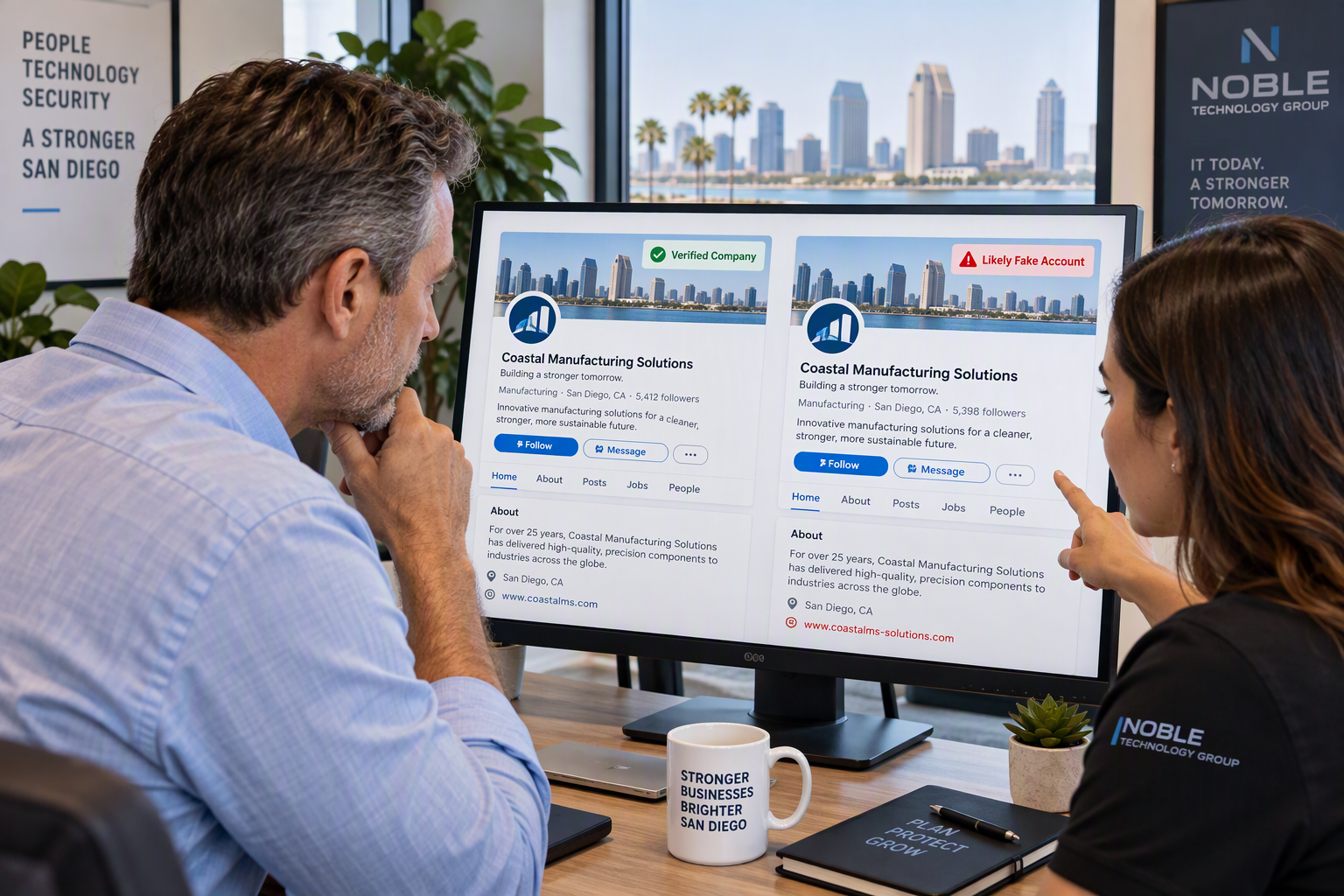
AI is making business impersonation more convincing. Strong cybersecurity, employee verification procedures, and managed IT services can help San Diego businesses reduce the risk.
Social Media Impersonation Is Getting Easier: How San Diego Businesses Can Protect Their Brand From AI-Powered Attacks
If your business is active on LinkedIn, Facebook, Instagram, or other social platforms, that visibility is probably there for a good reason. You want customers to find you. You want prospects to recognize your people. And you want your company to look credible when someone researches you online.
Unfortunately, cybercriminals want many of the same things.
The more information we put online about our businesses, leadership teams, employees, customers, and day-to-day activities, the more material criminals have to work with. Artificial intelligence has made that problem considerably more serious.
A criminal no longer has to settle for a poorly written email from a suspicious address. AI can help create convincing photographs, messages, fake profiles, audio, and even video. Pair those tools with information collected from your public social media footprint, and an attacker can create an impersonation that looks remarkably believable.
Your reputation has value. That makes it something criminals can steal.
Your Social Media Presence Is Now Part of Your Attack Surface
Most people hear "attack surface" and think about computers, servers, firewalls, email accounts, and cloud applications. Those things certainly matter. But attackers don't limit themselves to your network.
Information from company and employee profiles can help criminals identify leadership, accounting staff, vendors and reporting relationships. AI allows that information to be turned into convincing impersonation and social-engineering campaigns at scale.
- Fake executive or employee profiles
- Realistic phishing messages
- Synthetic photographs
- Voice and video impersonations
- Fake customer-service accounts
- Fraudulent company pages
- Highly personalized social-engineering messages
This is why I don't like treating cybersecurity as a collection of products. Good managed IT services need to address both technology and human behavior.
A Fake Identity Doesn't Have to Be Perfect
A fake identity only needs to be believable long enough for somebody to click a link, disclose credentials, approve a payment or share sensitive information.
- Clicking a phishing link
- Entering Microsoft 365 credentials
- Sharing confidential information
- Changing bank information
- Approving a payment
- Downloading malware
- Sending sensitive documents
The security question isn't, "Could somebody fake this?" Assume they can. Ask, "What happens next?"
Your Reputation Can Become the Phishing Lure
A well-made impersonation attack borrows trust your company has already earned. An account using your company name, logo, employee photograph and writing style can appear legitimate long enough to convince a customer or employee to act.
That's why monitoring brand impersonation should be considered part of a mature cybersecurity program rather than solely a marketing concern.
Your Employees May Be an Even More Valuable Target
Attackers may establish apparently legitimate professional relationships before requesting money, credentials, confidential reports or access.
When a request involves money, credentials, sensitive data, banking information or unusual access, employees should verify it using a separate, known communication channel.
AI Makes Executive Impersonation More Convincing
Voice and video impersonation make familiarity an unreliable form of authentication. Companies need repeatable processes for unusual financial requests, password resets and executive instructions.
- How do accounting employees verify payment changes?
- Can one person approve a large wire transfer?
- How are password resets validated?
- How do employees verify unusual executive requests?
- Who investigates fake social accounts?
Fake Accounts Can Damage Your Brand Without Breaching Your Network
Attackers don't need access to your network to damage your reputation. Fraudulent accounts can publish offensive content, impersonate customer service or offer fake products under your company's name.
This is where effective IT consulting needs to connect technology risk with business risk.
Build a Social Media Impersonation Response Plan
Before an incident
- Inventory official company social accounts.
- Document account owners.
- Require MFA wherever available.
- Use unique, strong credentials.
- Restrict administrator privileges.
- Document platform impersonation-reporting procedures.
- Train employees to report suspicious profiles.
During an incident
- Preserve screenshots and URLs.
- Report the impersonating account.
- Determine whether employees or customers were contacted.
- Investigate possible credential compromise.
- Look for related phishing activity.
- Preserve appropriate incident evidence.
Don't Forget About Cyber Insurance Requirements
Insurance applications and renewals can require businesses to document important security controls. The goal shouldn't simply be checking boxes. Your actual environment should match the representations your organization makes about its security.
If a security control matters enough to put on a questionnaire, it matters enough to verify.
Compliance and Social Engineering Are Connected
Good compliance services help businesses answer practical questions about access, sensitive information, incident detection, recovery and evidence.
If your business faces CMMC, NIST, HIPAA or other customer and regulatory requirements, your IT and cybersecurity strategies shouldn't operate separately.
Train Employees Without Making Them Afraid of Technology
Teach employees to pause when they encounter unexpected password resets, requests for credentials, urgent payments, banking changes, unfamiliar MFA prompts and requests to bypass normal procedures.
Most importantly, make reporting easy. Employees who think something feels wrong should be comfortable contacting IT immediately.
What I'd Ask Your Current IT Provider
- Do all of our critical accounts have MFA enabled?
- Who's monitoring suspicious sign-ins?
- What happens when an employee reports phishing?
- How do we verify unusual payment requests?
- Who administers our social accounts?
- Could former employees still access business accounts?
- Are our backups tested?
- Do our controls match our cyber insurance representations?
- What evidence could we produce for an auditor tomorrow?
- If our CEO were impersonated today, who takes charge?
Managed IT Services Should Reduce Business Risk, Not Just Close Tickets
When selecting managed IT services in San Diego, look beyond ticket resolution. Your technology partner should understand your business, cybersecurity risks, compliance obligations, recovery requirements and cyber insurance requirements.
Make Impersonation Part of Your Cybersecurity Plan
You don't need to panic about artificial intelligence. You do need a plan for a world where seeing a familiar photograph, hearing a familiar voice or receiving a message bearing your logo is no longer enough to prove somebody's identity.
If you're not sure where the gaps are, my team and I can help you figure that out.
Schedule an initial consultation with Noble Technology Group
We'll talk through your current IT environment, security concerns, compliance obligations and where your biggest risks may be. No scare tactics. Just a practical conversation about what your business needs to stay productive, secure and prepared.